Bayram Cigerli Blog

Bigger İnfo Center and Archive
  • Herşey Dahil Sadece 350 Tl'ye Web Site Sahibi Ol

    Hızlı ve kolay bir şekilde sende web site sahibi olmak istiyorsan tek yapman gereken sitenin aşağısında bulunan iletişim formu üzerinden gerekli bilgileri girmen. Hepsi bu kadar.

  • Web Siteye Reklam Ver

    Sende web sitemize reklam vermek veya ilan vermek istiyorsan. Tek yapman gereken sitenin en altında bulunan yere iletişim bilgilerini girmen yeterli olacaktır. Ekip arkadaşlarımız siziznle iletişime gececektir.

  • Web Sitemizin Yazarı Editörü OL

    Sende kalemine güveniyorsan web sitemizde bir şeyler paylaşmak yazmak istiyorsan siteinin en aşağısında bulunan iletişim formunu kullanarak bizimle iletişime gecebilirisni

How to Burn More Calories in Your Workout in 5 Steps

Do you know that you can burn 100 calories or more by adding something extra into your workout within spending more time? With 100 calories extra, in 35 sessions, you will be losing an extra one-pound of body fat on top of the total body fat that you will lose from your normal weight loss exercise routine.

This question became very popular because there are so many people out there that are hitting the weight loss plateau. They are exercising hard but yet they are not losing any more weight. This is very frustrating and sometimes can be very demoralizing. But you don’t have to worry now, I will share with you methods that I teach with my subscribers in Fast Fat Loss E-Mag on how to burn more calories during your workout.

Step one. Please get out of the fancy machine and hit the free weights and cables. There are many things that these machines cannot offer. Although they are highly engineered and are of latest technologies, they still do not train your muscle on balancing and coordination. The movement path is fixed and all you have to do is push. But with free weights, you need to balance the weights, focus on coordination, and focus on the power and speed of individual arm and also the movement path. This will burn more calories. Not only that, the muscle is worked more intensely. This will require more calories from the body for muscle recovery.

Step two, add in lunges into other exercises. Most of the time, people think that lunges is used only to work the butt, quads and hamstrings. But not many people know that lunges can be integrated into other exercises to make the exercise more complex and intense. A good example is dumbbell shoulder press with lunge. This exercise works the shoulders, the triceps, the core and the entire lower body. Rather than just sitting down on the bench and pressing the weights upwards, why not add in the lunges.

To perform this exercise, start by standing up with your feet side by side. Hold the dumbbells at shoulder height with your palms facing forward. And with one fluid movement, step out your right leg and drop vertically downwards until your left knee almost touches the floor. Press the dumbbells all the way up as you lower the left knee. Then step back to original position and repeat with your left leg.

There are many other exercise that you can add lunges to. You can add lunges to your dumbbell bicep curls, to your oblique twist with fitball and many more.

Step 3. Add squats into your other exercise. This is a similar concept of the lunges. By adding leg movements into your upper body movements, you almost double up your calorie burn. This is because the more muscle you exercise, the more calories you burn.

An interesting way you can add squats into your exercise is doing squats with your cable rows. First, stand up straight with the bar in your hands. Take a step back so that the weight stack is up. Then, instead of just bringing the bar to your stomach, squat down first, hold the position then bring the bar to your stomach. Return to the original position by extending your arms fully and the stand back up.

Step 4. You can also add in unrelated exercises in between sets. This means that instead of just resting one minute between a set of pull downs, why not do a set of crunches or a set of triceps press downs. This sort of supersets really can increase the intensity of the exercise and your heart rate.

You can also do chest exercises superset with abs, shoulder exercises superset with leg exercise. To take it another level higher, superset the weight training sets with a 2-minute high intensity cardio like uphill running or the Stair master

Step 5. Stick to large muscle groups and do only compound exercises. Large muscle groups like legs, back, chest and shoulders burns a lot if calories during a session of weight training. This because the size of these muscle groups are far larger than biceps and triceps. Use compound exercises to hammer these muscle groups. Compound exercises like squats, dead lift, chin-ups, barbell bench press and barbell shoulder press utilizes a lot of calories because lots of muscles are being worked at one time.

Use these tips to burn more calories in your workout session. We all could use additional helpful information to help us get our dream body faster. That is why I share a lot of latest weight loss tips in my newsletter Fast Fat Loss E-Mag.

Tony Leong is an experienced ACE personal trainer that had helped many people achieve their fitness goals. For a limited time only, you can download his weight loss system called Tony Leong.

BSA Students and Oxford Poetry

Several of the BSA Students wrote poetry. The following BSA students published in Oxford Poetry:
  • Roger Meyrick Heath (1889-1916), Oriel Coll.: 'The Crimson Box' (1910-13)
  • Richard Stanton Lambert (1894-1981), Wadham Coll.: 'East-End Dirge' (1914), 'For a Folk-Song' and 'War-Time' (1915)

John Ellingham Brooks

One of the more shadowy students at the BSA was John Ellingham Brooks (1863-1929). He had been educated at St Paul's College, Stony Stratford, Bucks., and then Peterhouse, Cambridge (1883-86; BA 1886). He was admitted at Lincoln's Inn (28 January 1887) and passed his Roman Law examination (1889).

In 1890 Brooks met (William) Somerset Maugham (1874–1965) in Heidelberg (see also Samuel J. Rogal, A William Somerset Maugham Encyclopedia [Greenwood, 1997]). Bryan Connon has noted:
Ten years his senior and an ostentatious homosexual, Brooks encouraged his ambitions to be a writer and introduced him to the works of Schopenhauer and Spinoza.
Brooks was admitted to the BSA in Ernest Gardner's last year as Director (1894/95). The reason stated was to do:
some preliminary work with a view to further research in another Session, especially in connection with the early Italian travellers in Greece, with the Greek teachers in Italy at the time of the Renaissance, and with the records and doings of the French and English travellers at the end of last and the beginning of the present century.
Brooks was re-admitted as an Associate in 1896/97 under Cecil Harcourt-Smith.

In 1895, the year of Oscar Wilde's imprisonment, Brooks and Maugham arrived on Capri. It was there Brooks met (Beatrice) Romaine Mary Goddard (1874-1970), an American citizen. Brooks and Goddard married on Capri on 3 June 1903; they separated after a year.

On Capri Brooks developed a close relationship with Edward Frederic Benson (1867-1940), another former student at the BSA (1891/92-1894/95). Benson recalled in As We Were (1930):
For several years I had been out here for some weeks of the summer, sharing the quarters of a friend of mine resident on the island, but now we had taken between us the lease of the Villa Cercola, and my footing in Capri was on a more permanent basis. ... the house was much bigger than Brooks's last habitation. (p. 339)
These events took place in 1914, but Benson had clearly been visiting Capri since 1895 (see Robert Aldrich, The Seduction of the Mediterranean: Writing, Art and Homosexual Fantasies [London: Routledge, 1993], 126) as he had been part of the circle of Goddard, Maugham and Brooks. The Villa Cercola was also leased with Maugham.

Brooks died in May 1929.

Every Picture Tells a Story, Dont It?

Well, I finally....got more photos online!

You can visit them here.

Or you can see Chris´pics here.

Mary Hamilton and the BSA

Mary Hamilton (1881-1962) was educated at St Andrews. Her father, Rev. William Hamilton, was the minister of the Trinity Evangelical Union Church in Dundee. (The church had been opened by James Morison [1816-93], founder of the Evangelical Union, in December 1877.) She held a fellowship from the Carnegie Trust (working on incubation) and was subsequently admitted to the BSA for the sessions 1905/06 and 1906/07. In Athens she met Guy Dickins (1881-1916) and they were married, c. 1909. Mary continued to use the address of her parents in Dundee.

Dickins was appointed lecturer in classical archaeology at Oxford in 1914 and they moved to 12 Holywell Street. Dickins was commissioned in November 1914 (Kings Royal Rifle Corps) and served in France; he died of wounds received on the Somme in 1916. Mary continued living at Holywell Street until 1917 when she moved to Bevington Road in Oxford. In 1925 she returned to Scotland, Callendar in Perthshire. She subsequently married Lacey Davis Caskey (1880-1944), curator of Classical Art at the Museum of Fine Arts in Boston and her contemporary in Athens at the American School (ASCSA); they lived in Wellesley, Mass.

Mary returned to Callendar in 1950.

Bibliography
Hamilton, M. 1906. Incubation, or, the cure of disease in pagan temples and Christian churches. London: W.C. Henderson & Son.
—. 1906/7. "The pagan element in the names of saints." Annual of the British School at Athens 13: 348–56.
—. 1910. Greek saints and their festivals. London: W. Blackwood & Sons.

Pantanal

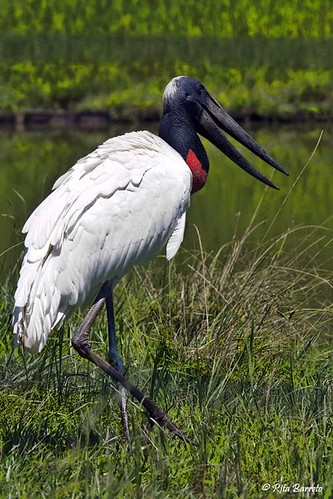
Tuiui (source)
We just got out of the Pantanal, where we spent 4 days. We had a great time - we went horseback riding, fishing for piranha, cayman hunting, and on an all day safari. We saw lots of birds, including blue macaw and toucans and a huge giant stork, called in Portuguese "tuiuiu", which is really fun to say. This bird is 1.5 meters tall (about 4-5 feet!) It is crazy! We also saw many, many caymans, a giant river otter and many capyvara, the largest rodent in the world, which looks like a huge guinnea pig and SWIMS! They have crazy animals. It was great!

We were hoping to see an anaconda and a giant anteater and a jaguar...or an anaconda eating an anteater and both of them being eaten by a jaguar... but it was not meant to be. We did see an anteater named Phillipe when we got to the border town of Corumba. It was really cool. He was really big and has no teeth but will suck on your fingers and lick you with his weird tongue. He does have large claws, but is basically like a big funny looking dog. (pics will be put online later)


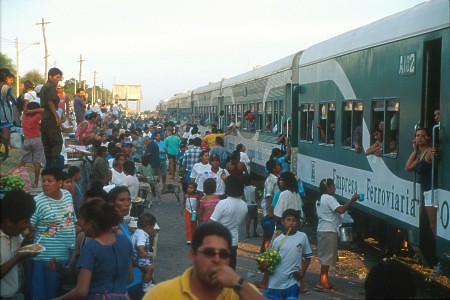
Now we are in Bolivia. We just arrived today after a long (23 hours) ride on the Death Train, which goes from Quijarros (the border) to Santa Cruz. The ride was good, although long, and we did not have any scary situations. The reason it is called the Death Train is because apparently in the 80s they used to carry a lot of contraband in the inside of the train and the people would ride on the top. The train used to derail a lot and many of the people on the top got killed. Hence the name. But now it does not derail as much and I did not see anyone riding on the top (or any contraband *wink, wink*)
Next stop, the Jesuit Mission Circuit, which is a few hours East of the town of Santa Cruz, where we are now. We are excited to be in Bolivia, but it is going to be hard to adjust to the temperature after being in the warmth of Brazil for so long! Where we are going in the next couple weeks, it gets way below freezing! Oh and now that I finally learned a few words in Portuguese, I have to switch my brain back to Spanish! Oh mio dios...

BSA Students and St Andrews

Only a small proportion of students admitted to the BSA had studied in Scotland. There was a single student from St Andrews. Mary Hamilton, originally from Dundee, graduated from St Andrews in Classics in 1902, and subsequently held a Research Fellowship under the Carnegie Trust (1903/04). This resulted in her study of Incubation, or, the cure of disease in pagan temples and Christian churches (1906) [WorldCat]. She was formally admitted as a student to the BSA in 1905/06 and 1906/07; in 1905 she was also admitted to the British School at Rome.

Three former students of the BSA were lecturers in St Andrews:
  • William John Woodhouse (1866-1937) was lecturer in Ancient History and Political Philosophy (1900). He had been admitted as a student at the BSA in 1889/90 and had subsequently been an assistant lecturer at Bangor (1896-99). In 1901 he moved to Sydney to be professor of Greek.
  • Adolph Paul Oppé (1878-1957) was a lecturer in Greek from 1902 immediately after his year in Athens (1901/02). In 1904 he was appointed lecturer in Ancient History at Edinburgh.
  • Alan John Bayard Wace (1879-1957) was appointed lecturer in Ancient History and Archaeology (1912-14) after a long-period as a student in Athens (first admitted 1902/03) and librarian for the British School at Rome (1905/06). He left St Andrews to become director of the BSA.

Weight Lifting Exercises For Women

Weight lifting is a common way to develop strength and size of skeletal muscle. It's very common for women nowadays as more and more women are looking forward in developing stronger muscles. The best part of weight lifting for women is to develop a stronger heart and stronger immune system. It also helps to control weight and offers protection against osteoporosis, a major disease which often occurs after menopause.

The importance of weight lifting for women should not be underestimated. If done properly they can be a successful athlete or an bodybuilder, weight lifting is now recognized to be an essential part of any fitness regimen and has gained incredible popularity over the last decade or so. Socially it's perfectly acceptable for women to take up weight lifting as a sport.

The biomechanical system of women and men are different though women has to work hard to get the similar results as men. The reason behind are physiological and hormonal. Men are typically stronger than women thus generate more force and men also produce ten times more testosteron than women. Testosterone helps in increasing muscle size. Thus, the concept is very clear that woman who has more testosterone may have a greater strength and power development than other women.

For developing the body, women must lift weight around forty five minutes twice in a week. It is always better to take your doctor's advice before hitting the gym and similary consult with a fitness expert before starting your exercise program.

It is better to start with strength development and the important thing is to learn the proper technique of weight lifting because without proper technique one can hurt themselves and cause serious damage. Once you got the technique then you can start with heavy weights. Equipment that plays major roles in weight lifting are dumb bells, calisthenic, free weight, weight machine and stretch bands.

Weight lifting has been proven to benefit everyone, as many women rely on low calorie diet and cardiovascular activity to enhance physical appearance.

Edebiyatımızda bir mihenk taşı: "Leyla ile Mecnun"

Edebiyatımızda Bir Mihenk Taşı: "Leyla ile Mecnun"


Mecnun, bir kabile reisinin dualar ve adaklarla dünyaya gelmiş olan Kays adlı oğludur. Okulda bir başka kabile reisinin kızı olan Leyla ile tanışır. Bu iki genç birbirlerine aşık olurlar. Okulda başlayıp gittikçe alevlenen bu macerayı Leyla‘nın annesi öğrenir. Kızının bu durumuna kızan annesi, kızına çıkışır ve bir daha okula göndermez. Kays okulda Leyla‘ yı göremeyince üzüntüden çılgına döner, başını alıp çöllere gider ve Mecnun diye anılmaya başlar.


Mecnun‘ un babası, oğlunu bu durumdan kurtarmak için Leyla‘yı isterse de Mecnun (deli, çılgın) oldu diye Leyla’ yı vermezler. Leyla evden kaçarak, Mecnun‘ u çölde bulur. Halbuki o, çölde âhular, ceylanlar ve kuşlarla arkadaşlık etmektedir ve mecâzî aşktan ilâhî aşka yükselmiştir. Bu sebeple Leylâ’ yı tanımaz. Babası Mecnûn’ u iyileşmesi için Kâbe’ ye yasal kelımeürür. Duâların kabul olduğu bu yerde Mecnûn, kendisindeki aşkını daha da arttırması için Allahü Tealâya duâ eder:
“Ya Rab belâ-yı aşk ile kıl âşinâ beni
Bir dem belâ-yı aşkdan etme cüdâ beni.”


Duâsı neticesi aşkı daha da çoğalır ve bütün vaktini çöllerde geçirmeye başlar. Diğer tarafta ise Leylâ da aşk ıstırabı içindedir.


Bir zaman sonra âilesi, Leylâ’ yı İbn-i Selâm isimli zengin ve îtibârlı birine verir. Ancak, Leylâ kendisini bir perinin sevdiğini ve eğer kendisine dokunursa ikisinin de mahvolacağını söyleyerek İbn-i Selâm’ ı vuslatından uzak tutmayı başarır.


Mecnûn, çölde, Leylâ‘ nın evlendiğini arkadaşı Zeyd’ den işitince çok üzülür. Leylâ’ ya acı bir sitem mektubu gönderir. Leylâ da durumunu bir mektupla Mecnûn’ a anlatır. Kendisini anlamadığından dolayı o da sitem eder.


Bir müddet sonra Mecnûn‘ un âhı tutarak İbn-i Selâm ölür. Leylâ baba evine döner. Bir çok tereddütten sonra her şeyi göze alarak, Mecnûn’ u çölde aramaya başlar. Fakat Mecnûn, dünyadan elini eteğini çekmiş ilâhî aşk yüzünden Leylâ’nın maddî varlığını unutmuştur. Leylâ, çölde Mecnûn’ u bulduğu hâlde, Mecnûn onu tanımaz. Leylâ onun erdiğini anlarsa da yine onsuz yaşayamaz. Hastalanıp yataklara düşer. Kısa zaman sonra da ölür. Mecnûn, Leylâ’ nın ölüm haberini öğrenir. Gelip mezarını kucaklar, ağlayıp inler;

“Ya Rab manâ cism ü cân gerekmez
Cânânsuz cihân gerekmez.”


Der, kabri kucaklayarak ölür. Bir müddet sonra Mecnûn‘ un sâdık arkadaşı Zeyd rüyasında, Cennet bahçelerinde birbiriyle buluşmuş iki mesut sevgili görür. Bunlar kimdir? diye sorunca, derler ki:


“Bunlar Mecnûn ile onun vefalı sevgilisi Leylâ’ dır. Aşk yoluna girip temiz öldükleri, aşklarını dünya hevesleriyle kirletmedikleri için burada buluştular.”


——————


Leyla ile Mecnun’un aşkları bir Arap efsanesine dayanmaktadır. Bu efsanede Mecnun mahlasıyla şiirler söyleyen Kays ibni Mülevvah adlı bir Arap şairiyle Leyli ( Leyla ) adlı bir Arap kızın arasında geçen ve ayrılıkla sona eren bir aşk serüveni anlatılmaktadır.


Söylentiye göre Kays ile Leyla kardeş çocuklarıdır. Küçük yaşta birbirlerini severler. Kays’ın Leyla için söylediği şiirler dillerde dolaşır. Leyla’nın babası ,adını dillere düşürdüğü için kızının Kays’la evlenmesini önler. Leyla başka biriyle evlendirilir. Kays çöllere düşer. Mecnun (deli ) diye anılmaya başlar. Ayrılık acısına dayanamayan Leyla kederinden ölür. Mecnun bunu duyunca onun mezarının başına koşar ve o da orada can verir. Bu efsane Arap edebiyatında X. yüzyılda çok yaygın bir hale gelmiş ,Mecnun’a ait olduğu söylenen şiirlerin arasına nesirler de eklenerek hikaye haline getirilmiştir. Bu konu daha sonra Fars ve Türk edebiyatlarında da işlenmiştir.


Bunların arasında en ünlüsü Fuzuli‘nin yapıtıdır ( 1535) Aşağıda okuyacağınız küçük hikaye Fuzuli`nin Leyla vü Mecnun adlı mesnevisinden alınmıştır. Kays, bilinen adıyla Mecnun, Leyla`nın aşkından kendisinden geçip yarı meczup bir halde çölde giderken, namaz kılmakta olan bir dervişin önünden geçer. Derviş hemen namazını selamlayıp, Mecnun’a “Namaz kılan birinin önünden geçilmez, bunu bilmiyor musun?” diye çıkışır. Mecnun cevap verir “Ben Leyla’nın aşkından öyle bir hale geldim ki, senin burada namaz kıldığını görmedim bile, sen nasıl bir aşkla namaz kılıyorsun da benim senin önünden geçtiğimi görüyorsun?” Leyla ve Mecnun’un hikayesi Türk Halk edebiyatının da etkilemiş ve Leyla ile Mecnun adıyla bir Karagöz oyunu haline getirilmiştir. Karagöz oyunlarında işlenen Leyla ile Mecnun hikayesi ise şöyle : Oyunun başında Leyla ile Mecnun birbirlerine olan sevgilerini şiirlerle dile getirirler.


Aralarında bir gül ağacı vardır. Zebani gelerek gül ağacını alır ve yerine karaçalı koyar. Karagöz bu karaçalıyı almak isterken zebani Karagöz‘ü kaldırıp baş aşağı kara çalının üzerine atar. Hacıvat gelerek Karagöz’e Leyla ile Mecnun’un hikayesini anlatarak, Zebani’nin kara çalıyı onları ayırmak için koyduğunu söyler. Perdeye içinde Leyla’nın babası ve annesinin olduğu bir kervan gelir. Hacıvat onlara bir ev bulur. Daha sonra Mecnun’un babası olan Halepli Haşim gelir. Hacıvat Leyla’nın anne ve babasının olduğu yere ergeç Mecnun’un da geleceğini söyler. Mecnun gelip Leyla’ya olan aşkını Hacıvat’a anlatır ve ondan yardım ister. Bu esnada bir aslan gelip Karagöz’ün köpeğini yutar. Leyla’nın babası kızını Mecnun’a istemeye gelen Hacıvat’ı kovar.


Hacivat, Karagöz‘ün ninesi olan Cazu’dan yardım ister. Cazu nine Leyla’nın babasına giderek eğer kızlarını Mecnun’a vermezlerse Leyla’nın öleceğini söyler. Bunun üzerine Leyla’nın babası kızını Mecnun’a vermek için üç şart koşar. Birincisi Mecnun çok sevdiği dişi ahuyu öldürecektir. İkincisi aslan ile boğuşup onu da öldürmesi. Üçüncüsü ise yedi başlı ejderhayı öldürmesi. Karagöz Mecnun’a bir bıçak verir. Mecnun kendi isteğiyle ahuyu öldürür. Daha sonra aslan ile ejderhayı da öldürür ve koşulları yerine getirmiş olur. Zebani iki sevgilinin kavuşmasını engellemek amacıyla araya yine kara çalı koyarsa da Mecnun bıçağı ile karaçalıyı kesip atar. Sevgililer birbirlerine kavuşurlar ve kervanla memleketlerine dönerler…


LEYLA ve MECNUN


Ey Rabbim! Aşk belasıyla beni tanıştır
Beni bir an bile olsa; aşk belasından ayırma!


Detlilerden yardımını uzak tutma.
Yani beni daha çok belalara müptela eyle!


Ben var oldukça, beladan, isteğimi uzaklaştırma!
Ben belayı isterim, çünkü bela da beni ister.


Sevgi belasıyla ağırbaşlılığımı gevşetme!
Ta ki dostlar beni kınayıp vefasız demesinler!


Gidip geldikçe, sevgilimin güzelliğini arttır,
Sevgilimin derdine beni daha çok mübtela et.


Ben nerede, mevki ve itibar kazanma nerede?
Bana yoksulluk ve yokluk ulaşma kabiliyeti ver


Senden ayrıyken, bedenimi öyle zayıf kıl ki,
Bahar yeli beni sana kavuştursun.


Fuzûlî’ nin nasibi gibi beni gururlandırıp,
Ey Rabbim, asla beni bana bağlı kılma!


Sonunda yar, ağlayıp inlememize acıdı ve
Bugün hüzünler evimize ayak bastı.


Gözyaşı yağmurum, demek, öyle tesir etti ki,
Gül bahçemizde taze bir gül dalı düşürdü.


Ah ateşinin bizi yaktığı,
Ayrılık gecesini aydınlatan meş’ aleden bellidir.


Eğer ağlayan gözümüzde uyku olsaydı,
Bu kavuşma uyku halinde görülen bir rüya demek mümkün olurdu.


Gördüğümüz bir hayal mi?
Yoksa sevgilinin yanımıza geleceği aklımıza bile gelmezdi.


Ey can ve gönül! Sevgili, misafirimiz oldu!
Neyimiz varsa, misafirimizin ayaklarına dökelim.


Ey Fuzûlî! Sevgilinin kasdı, canımızı almakmış.
Gel.. Güzel uğruna can vermeyi kendimize bir borç bilelim.


**
Fuzûli’ nin 1535′ te yazdığı
Leylâ ve Mecnûn adlı mesnevîsi