
A TRIBUTE TO THE LEGENDS OF MUSIC with Michael Antoniou
Anesi Restaurant, Peyia
Thursday 20 August - doors open 1830, music begins 2000
Tickets €20pp including a 3 course meal.
Seating limited so booking is essential - 99 313050, or 99 379060


Hızlı ve kolay bir şekilde sende web site sahibi olmak istiyorsan tek yapman gereken sitenin aşağısında bulunan iletişim formu üzerinden gerekli bilgileri girmen. Hepsi bu kadar.

Sende web sitemize reklam vermek veya ilan vermek istiyorsan. Tek yapman gereken sitenin en altında bulunan yere iletişim bilgilerini girmen yeterli olacaktır. Ekip arkadaşlarımız siziznle iletişime gececektir.

Sende kalemine güveniyorsan web sitemizde bir şeyler paylaşmak yazmak istiyorsan siteinin en aşağısında bulunan iletişim formunu kullanarak bizimle iletişime gecebilirisni

The government will use this information to contact you if you or someone you’ve travelled with develops coronavirus (COVID-19) symptoms.
If you need to self-isolate for the first 14 days after you arrive in the UK, the government will also use the information to check that you’re self-isolating.
You may be fined up to £100 if you refuse to provide your contact details, or more if you break this rule more than once. You also may not be allowed to enter the UK (unless you’re either British or a UK resident).
 |
| Princess Marie Gabrielle of Luxembourg |
 |
| Newlyweds: Count Knud of Holstein-Ledreborg and Princess Marie Gabriele of Luxembourg. |
 |
| Knud and Marie Gabrielle with their seven daughters. |


Mexico has recorded more than 9,000 daily coronavirus cases for the first time, as the country overtook the UK with the world’s third-highest number of deaths from the pandemic after the US and Brazil.
The surging numbers were reported as the World Health Organization warned of “response fatigue” and a resurgence of cases in several countries that have lifted lockdowns.
Tedros Adhanom Ghebreyesus, director general of the WHO, said: “Many countries that believed they were past the worst are now grappling with new outbreaks. Some that were less affected in the earliest weeks are now seeing escalating numbers of cases and deaths.”
Mexico, which like many countries has lifted tight restrictions imposed earlier this year, reported a record 9,556 new cases on Saturday. It also announced 784 additional fatalities, bringing its total to 47,472 deaths.
An emergency WHO committee reviewing the pandemic noted the “anticipated lengthy duration of this Covid-19 outbreak” required a sustained response, according to a statement from the UN body released on Saturday.
It said nuanced, pragmatic guidance was needed to reduce the risk of response fatigue in the context of socioeconomic pressures.
There have now been almost 17.8m confirmed cases around the world and more than 684,000 deaths, according to Johns Hopkins University.
South Africa, which gradually loosened a strict lockdown imposed at the end of March, reported it had counted more than half a million cases at the weekend. The country is by far the hardest-hit in Africa and accounts for more than half of diagnosed infections.
So far, the number of fatalities stands at 8,153. However, local researchers have recorded a jump of nearly 60% in natural deaths in recent weeks, suggesting a much higher toll of coronavirus-related fatalities than officially registered.
But President Cyril Ramaphosa said on Saturday that South Africa’s case fatality rate stood at 1.6%, well below the global average. “While South Africa has the fifth-highest number of total Covid-19 cases globally, we have only the 36th highest number of deaths as a proportion of the population,” he said.
Meanwhile, India reported nearly 55,000 new coronavirus cases, down from the previous day’s record 57,118 but raising the country’s total to 1.75m. The month of July accounted for more than 1.1m of those cases.
The country’s interior minister, Amit Shah, said on Sunday that he had tested positive for coronavirus and had been admitted to hospital. Shah, a close aide to Narendra Modi, the prime minister, heads a key ministry that has been at the forefront of managing India’s coronavirus outbreak.
 © Photograph: Jorge Núñez/EPA Officers check people’s temperatures on bus passengers at a checkpoint in Mexico City.
The Australian state of Victoria has declared a state of disaster and placed Melbourne, the country’s second-biggest city, under night-time curfew as it grapples with hundreds of “mystery cases” of coronavirus.
Under the six-week so-called stage 4 lockdown, no one will be allowed to venture further than 5km (3.1 miles) from their home, only one person per household per day will be allowed to go shopping, and only one hour of exercise will be permitted.
Seven health officials from China were due to arrive in Hong Kong on Sunday, the first members of a 60-person team that will carry out widespread testing for Covid-19 in the territory as it races to halt a third wave of the illness.
In the Philippines, infections surged past 100,000 on Sunday, after medical groups declared that the country was waging a losing battle against the virus and asked the president to reimpose a lockdown in the capital.
The country has the second-highest number of cases in south-east Asia after Indonesia and has had more infections than China, where the pandemic began late last year.
President Rodrigo Duterte eased a severe virus lockdown in the capital, Manila, a city of more than 12 million people on 1 June, after the economy shrank slightly in the first quarter, its first contraction in more than two decades.
France and Spain, two countries that imposed stringent lockdowns earlier this year, have both also experienced recent surges in cases, while in the UK, Boris Johnson was reportedly considering new lockdown measures in England.
In Israel, a steep rise in cases and the government’s bungled economic response has seen protests grow in size. On Saturday night, thousands of protesters gathered in Jerusalem and Tel Aviv to call for the resignation of the prime minister, Benjamin Netanyahu, who also faces corruption allegations.
Agencies contributed to this report.

Definition of a suspected case in the community (Algorithm 1)
Patient with symptoms1 :Self-isolation may be stopped once 14 days have passed from the improvement of the symptoms.
1 Note: Less common symptoms include sore throat/ dry throat/ nasal congestion/ runny nose/ anemia, headaches and gastrointestinal symptoms (vomiting, diarrhoea). Loss of taste and smell can also be a symptom. Caution is required here as symptoms such as runny nose, sneezing, runny eyes, itching are most likely due to a seasonal allergy.
Management of suspected case that requires referral to Public Health Practice (Algorithms 1 AND 2)
Respiratory infection (without other clear cause) and at least one:
Recommendation for referral from GP to Public Health Practice by appointment, completion of electronic referral form or calling 1420, laboratory testing for COVID-19 and assessment of severity (see algorithm)
Criteria of severity of patient for hospitalisation (Algorithm 2 AND 3)
Patients with acute respiratory infection referred by Public Health Practice, 1420 or from A&E Dept and has at least one of the following conditions:
Recommendation for laboratory testing for COVID-19 and Influenza A&B, admission to hospital (Suspected Case Management Unit) and appropriate management.
Note: Laboratory findings supporting the potential diagnosis of COVID-19 are: Lymphopenia (<1000/mm3), Neutrophil/lymphocyte ratio >3, High Ferritin, Increased D-Dimers, Increased LDH, Hyperglycaemia, Thrombocytopenia, TransaminaseCriteria for Laboratory Testing of Hospitalised patients (Algorithm 4)
2 of the following 3 criteria must be met for laboratory testing of a hospitalised patient:For any other case please contact the Infectious Disease Officer at the Suspected Case Management Unit.
Samples for laboratory testing for COVID-19 to be taken as well as Influenza A&B or Multiplex Respiratory Panel by designated staff for specimen collection.
Transfer to single bed room or to Suspected Case Management Unit until infection is confirmed/ ruled out.

With the 88 new covid-19 positive incidents announced this week, Cyprus is now at April levels. April had started with a record number of 232 incidents in the first week, followed by a downward trend and in the last week of April the number was reduced to 50.
What is worrying in this case is the fact that April was the month in which the most stringent restrictive measures were applied, which led to zero incidents. For example, in the last week of May the total number of incidents reached 9, while a similar situation prevailed throughout June.
See the table attribute

Eleven new incidents of coronavirus were announced in the afternoon in Cyprus, with the total number amounting to 1,150.
With regard to new cases of COVID-19, according to data from the Epidemiological Surveillance Unit of the Ministry of Health, a total of 1,977 laboratory diagnoses identified an additional 11 cases of SARS-CoV-2.
Earlier, another 15 incidents of coronavirus, 10 of Limassol's sample checks, had been announced.
In detail, virus-positive individuals emerged as follows:
The 15 cases announced this morning concern:
A) The four are close contacts who went private for the test. From the cluster of the case from the USA.
B) 1 is a Portuguese footballer. He came from Portugal on 27/7 and took the test at the initiative of his team.
Also, the 11 new cases announced this afternoon concern:
In addition, 103 laboratory diagnoses were carried out by the Microbiological Laboratories of the General Hospitals, without the detection of a case.
Based on the data so far, the total number of positive cases amounts to 1,150.
Source: Eyenews

By Nicholas Karides
Never before have the media, that is the civically useful type that produce independent quality journalism, come under such relentless pressure and criticism. The gatekeepers, those tasked to speak truth to power, are increasingly being questioned by authorities and snubbed by the public whom they are meant to serve.
In the US, lauded until recently as the hub of absolute press freedom, an infantile but sinister president launches personal attacks on journalists and degrades the profession. In Hungary, an EU member state, the government intimidates and stifles media freedom while in Turkey, a once aspiring candidate state, the government just locks journalists up at will.
Populist leaders, their poisonous discourse and the unchecked new technologies that allow the spread of disinformation are shaking the people’s trust in the media and by consequence redefining the media landscape altogether. Yet, as Donald Trump and Viktor Orban ride the trend, it is useful to remember that the media have always been subject to political pressure and interference while their commercial viability has always been at the mercy of their owners’ whims or capitalism’s frequent breakdowns. Which is why the national contexts in which they operate have, rightfully, always come under scrutiny by independent monitors.
Their aim is to assess the quality of the media, the environment in which they operate and ultimately to help establish the quality that can command the public’s trust. Scrutiny of this constructive kind was released last week by the Centre for Media Pluralism and Media Freedom of the European University Institute in Florence. The Media Pluralism Monitor 2020, co-funded by the European Union, examined the health of media ecosystems in EU member states, including a now departed member state, the UK, as well as in Albania and Turkey.
Four key risk areas were assessed: Basic Protection, i.e. rights and access to information, the working conditions of journalists and the effectiveness of media authorities; Market Plurality which assesses the legal and economic environment, transparency of ownership, media concentration, viability, and owner influence on editorial content; Political Independence, i.e. the autonomy of the newsroom, political control and influence, election coverage, advertising, regulations and funding, and, last, Social Inclusiveness which examines the degree of media access for minorities, women and people with disabilities as well as the overall level of media literacy and protection against hate speech.
The MPM2020 found that Basic Protection remains strong overall with the majority of the countries considered low risk and only one, Turkey, seen as high risk. However, when it came to Market Plurality, risks of commercial and owner influence over editorial content have risen with only five countries deemed low risk (Denmark, France, Germany, Portugal and the Netherlands) with 11 at medium risk (Austria, Belgium, Cyprus, Estonia, Finland, Ireland, Italy, Luxembourg, Poland, Spain and the UK) and the remaining 14 at high risk.
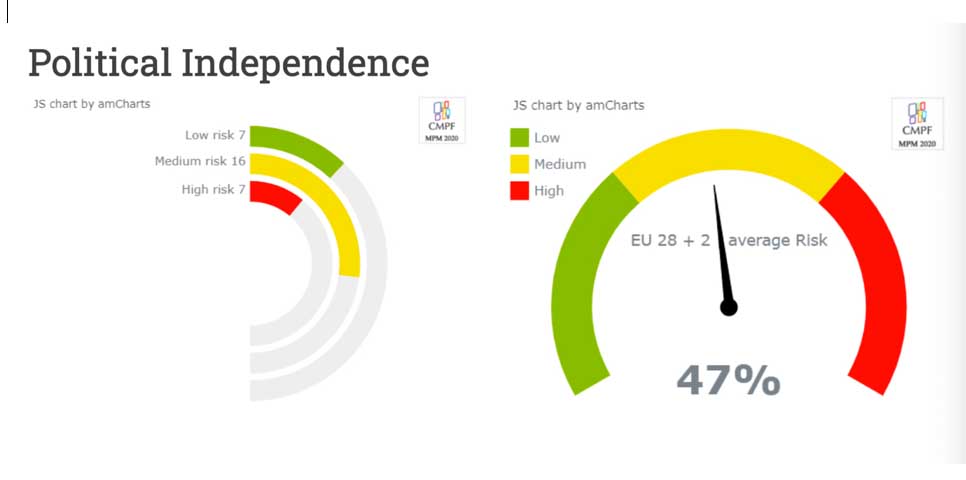
Serious concerns also emerged on Political Independence with Malta, Hungary and Poland along with Bulgaria, Romania, Slovenia and Turkey found to be high risk. Only Belgium, Denmark, France, Germany, the Netherlands, Portugal, and Sweden were low risk; the majority, including Cyprus, fell within the medium risk range.
As disinformation eats away at objective reporting, media literacy, the capacity to understand what is fake or biased, has become a key factor. Only six countries were found to have comprehensive media literacy policies. Five, Albania, Croatia, Hungary, Romania and Cyprus have no media literacy policy at all.
Cyprus’ risk level
In terms of Basic Protection, constitutional and legal provisions continue to offer citizens safeguards and effective protection of their rights connected to freedom of expression but there are areas of concern such as digital underdevelopment while the right to access to information still requires legal recognition.
The situation is poorer on Market Plurality. The law does ensure transparency in media ownership and avoidance of cross media concentrations but only in broadcasting. An outdated and deficient press law and the absence of a digital media legal framework as well as the increased corporate influence and pressures on journalists’ employment conditions are problems, heightened by lack of reliable data.
Editorial independence in Cyprus is in principle warranted by both regulatory and self-regulatory provisions. However, the rules make very limited provisions on the effective protection of journalists and the avoidance of political interference into their work. The key issue remains the pursuit of the political agendas of media owners, sometimes without any visible interference and often led by corporate rather than actual political aims. This enforces a degree of self-censorship and compliance among editorial staff.
Crucially, a subculture of informal relations exists between the political class and media owners and journalists which more than any other factor affects focus, topic selection and nuancing. There are also recurring problems with the governance and funding of Cyprus’ public service media, CyBC, and the influence the government and political parties retain over it.
Where Cyprus fares badly is Social Inclusiveness. Access to the media is mostly reserved for mainstream groups with minorities, women and other social actors sidelined despite evolving plurality and multiculturalism. Much needed media literacy actions are limited and lack policy direction despite valiant efforts by academics and other stakeholders.
And though media literacy may be seen as the least important in terms of immediate impact and a country’s overall image, it is potentially the most significant in terms of achieving better across-the-board results in the future. A well-informed media-literate populace is more likely to demand Market Plurality and not likely to tolerate Political Interference.
Trumpism and Orbanism are the result of complex factors. Media literacy would certainly not have prevented them. But it can be argued that for a confused public caught between populist politics, fragile economics and a hounded media it might make just enough of a difference to avert total disaster in the future.
Nicholas Karides was one of the Cyprus experts for Media Pluralism Monitor 2020 along with team leader Christoforos Christoforou. Individual country reports can be accessed at https://cmpf.eui.eu/mpm2020-results/
@NicholasKarides


 Kayıtlar
Tüm Yorumlar
Kayıtlar
Tüm Yorumlar


