Bayram Cigerli Blog

Bigger İnfo Center and Archive
  • Herşey Dahil Sadece 350 Tl'ye Web Site Sahibi Ol

    Hızlı ve kolay bir şekilde sende web site sahibi olmak istiyorsan tek yapman gereken sitenin aşağısında bulunan iletişim formu üzerinden gerekli bilgileri girmen. Hepsi bu kadar.

  • Web Siteye Reklam Ver

    Sende web sitemize reklam vermek veya ilan vermek istiyorsan. Tek yapman gereken sitenin en altında bulunan yere iletişim bilgilerini girmen yeterli olacaktır. Ekip arkadaşlarımız siziznle iletişime gececektir.

  • Web Sitemizin Yazarı Editörü OL

    Sende kalemine güveniyorsan web sitemizde bir şeyler paylaşmak yazmak istiyorsan siteinin en aşağısında bulunan iletişim formunu kullanarak bizimle iletişime gecebilirisni

Nukufetau Journal

Nukufetau
October 7 - October 16


Due to wind direction (and strength) we decided to anchor in the southeast corner of the lagoon, rather than in front of the small village of Nukufetau.  We were instantly welcomed by the local police officer, Tesio, who checked our paper work and offered to show us the WWII B-17 plane wreck.  We, along with Island Sonata, met him on one of the islets where he was coconut crab hunting.  He took us into a magnificent jungle to the wreck site.  This trek north has really sparked our interest in the second World War.  To try and imagine young men (boys really) landing on, fighting, and defending these small atolls is overwhelming.  To actually see and touch real relics from the war adds a reality to the history.  It's a bag of mixed emotions as we curiously explore the intriguing sites, saddened by the thought of the thousands of men/boys who died.

Afterwards we sat on the beach with Tesio talking a little and enjoying the shade and view of the turquoise lagoon.  He sent us away with two coconut crabs and a huge smile.

Back on our boat Chris got to work cleaning the large Tuna, which I had shoved head first, tail nearly sticking out, into the frig the night before (it was too rolly on passage for us to want to deal with the mess of cleaning the fish).  I hadn't realized just how big the guy was until mounds upon mounds of tasty red flesh started piling up.  We had Island Sonata over for dinner, where we got a little carried away with sesame seared tuna, four different types of tuna rolls, tuna sashimi, tuna sushi, the two coconut crabs, and a cucumber salad (because I was worried we wouldn't have enough food!).  It was YUMMY, and took away all and any guilty thoughts leftover from the act of killing a living thing!

The next morning another local (Famasino) stopped by to say Mauri (hello) and gave both boats some fish!  Barely here a day and we were already overwhelmed by the generosity.  We could also feel a difference between the less populated Nukufetau and the crowded Funafuti ... just in the two interactions we'd had we could sense to higher level of curiosity and felt a warmer welcoming.

Chris went off with John to gather some coconuts and look for coconut crabs while I scrubbed down the cockpit to clear away the lingering fish smell (from the killing and cleaning of the tuna).  Later Chris and MJ grated and squeezed the coconut for fresh coconut milk, which I used to make Kokoda (like Seviche with the fish soaked in lime juice, but served in coconut milk).  We had MJ & John over for another huge feast; more tuna rolls and sashimi, Kokoda, and spicy seared tuna.  About an hour after eating, as we were all lounging around trying to digest mass amount of food, I began to get really really hot.  I tried sitting right in the breeze, but I felt flushed, as if I was having a massive hot flash.  Chris and John took off to check their coconut crab traps (which turned out to be empty) and I went down below to do a few of the dishes ... turning on the light I discovered I was a deep red color - all over my body, as if I had laid out in the sun for 10 too many hours!  MJ and I figured it must be some type of allergic reaction, so I took a Benedryl and returned to the cockpit to lay in the breeze.  My sunburn look continued until about three in the morning, but otherwise I felt alright.

The next morning I took a cursory glance through our medical book, but found nothing describing my symptoms.  I figured it was some fluke allergy, and since it wasn't that bad and the fish was that good, I served leftovers to Chris and I for lunch.  This time I didn't eat very much though (just in case) ... and it was probably a good thing because less than twenty minutes after lunch I was turning red again!  This round was worse, I felt dizzy, a bit sick, and my heart was working overtime -- it was beating so hard and fast I was convinced you should be able to see my whole chest move.  I took a couple more Benedryl (since they seemed to help the night before) and laid inert under our hatch.  A few hours later I was feeling much better, and we had also learned that both John & MJ had had a small bout of stomach problems the night before.  Chris however, with his stomach of steel, didn't have any problems at all.  I hit the medical book again, and this time also used our fish books ... finally I found it ... Histamine Poisoning!  Most likely caused because we either didn't clean the fish soon enough or because our refrigerator wasn't cool enough.  Bummed, we had to throw the rest of the tuna overboard.  We spent the next week monitoring frig temperatures, adding insulation and we added a little fan to help circulate the air and maintain a more consistent temp.  As it turns out our frig is now running a bit less and seems to be cooler.

Starting that night a huge convergence zone hit us, and with it came cloud cover, rain, and lots of lightning.   For three days we kept most of our electronics in the oven and tried to enjoy the impressive show that mother nature put on; blinding flashes followed by crackling thunder, both near and far.  During the rainy periods we played cards with Island Sonata and ate a lot (what else does one do when trapped 'indoors'?)  On the bright side of things we were loaded up with water and ready to do some mass amounts of laundry, should the sun ever surface again!  In between down pours on the 11th, we went in to visit Famasino and his wife Salani.  They are the only locals who live (sometimes) away from the main village (although they also have a house in the village).  Salani  gave us a tour which included dense jungle, a well from WWII, and the airstrip used in WWII -- now so overgrown you'd never guess a plane every landed there!  Afterwards we all went over to Island Sonata where we feasted on coconut crabs, chicken, and rice (all provided by Famasino & Salani).  They seemed to get a good laugh watching Chris as he enthusiastically tore into the crab.  He was also the only Palagi brave enough to try the supposedly eatable intestine thing along with some funky juice stored in the center body of the crab (what we nick-named Butt Butter).  When Chris left to get some fishing supplies from Billabong, Salani laughed and said, "Chris, he likes to eat!".  While they grossed us out with their intestines and butt butter, we did they same when we offered them a coconut-peanut butter balls for dessert ... they were polite enough to try and eat them but they couldn't quite control the nasty faces!  I can't believe it, who doesn't like peanut butter and coconut?

Wednesday the sun finally returned ... the only downside being that now I had no excuse to not do the laundry!

Thursday we took off for a walk around the south side of the islet.  It was HOT!  After making our way around and to the outside (or ocean side) of the atoll the debate as to when we should cross over (through the atoll jungle) began.  No one was 100% sure of just how far we needed to go in order to come out at the right spot on the other side!  Chris would pop into the jungle on occasion to scout it out, and on one such occasion made a very neat discovery.  He found two slabs of concrete buried under layers of bush where Marine Core men from WWII had carved their names.  We could only make out the names of one of the carvings; Al Zuro of the U.S.M.C. dated 10-17-43.  He had also carved what appears to be his wife's name and a heart with A.Z. and M.Z. carved inside.  Standing there images flashed through my mind; a young man maybe 21 max, probably just married before being shipped off to some unheard of atoll in the middle of nowhere, sweating away in the jungle, a cigarette in his mouth, a picture of his new young wife in his pocket.  Probably hadn't had children yet.  I can almost see his face, his smile.  And then what?  It was November of 1943 when the US marines attacked Betio, Tarawa  -- with horrific losses --  was he sent there?  Did he survive?  We hope that perhaps we can find out, who knows what we'll discover.

Finally, still not sure where we should head across we just went for it ... and more or less got lost.  A bit embarrassing to admit if you consider that from edge to edge across the atoll was no wider than a few hundred feet -- But this was some thick jungle ... and we had no compass -- all we had for our sense of direction was the pounding surf that marked the outside of the atoll (which we were trying to go away from).  After turns and loops, we literally cut our way through (via machete), finally finding the white sandy beaches that marked the lagoon side of the atoll.  We had cut across WAY too soon, no big deal as we could easily continue walking on the lagoon side, but farther down we came across the narrow part of the atoll - the part where you could practically see across from one side to the other - the part with a PATH!!!  Well, at least we had an adventure!

On Friday (the 14th), Camira and Freebird arrived.  We all gathered for a swim under Island Sonata's boat.  A local boat was passing and pulled close to say hello -- strange glances from all of them as they puzzled over the crazy laughing white people floating around (on water/pool toys) under the boat!!!  (We call the area under Island Sonata's catamaran "the pool"; we swim there because it's shaded from the hot tropical sun).  After our swim the men went off hunting for coconut crab. Unfortunately they came back empty handed, lucky for us I stock up on all those canned goods!!!

Saturday it was calm enough for a trip to the village.  All eight Palagi's piled aboard Freebird and we motored across the lagoon to the village.  We spent the day walking around the small village, escorted (or surrounded depending on how you look at it) by a large group of children.  We sang songs, skipped, raced, and played games.  For such a small village in such an out-of-the-way place we were surprised at how modernized it was (compared with other such places).  One family keeps their coconuts in the freezer -- what a refreshing drink that is!  Some of the modernization was a bit disappointing.  Camira had brought an old sail courtesy of another boat to be given to one of the families in the village.  The donator had figured they could use it for their canoes or homes, but as we were leaving the guy said, "and thank you again for the sail, it will provide good shade for when my family goes on a picnic".  Well, not quite the functional, practical, necessity type of use we had figured on.  Later Camira remarked that he wished he had saved the sail brought it to Onotoa (Kiribati), where they actually used sails for their canoes which they fished from.  Anyway, the people were once again beyond welcoming & friendly and we really enjoyed the visit.

Sunday we prepared for our upcoming departure.  We also had a goodbye visit from Famasino & Salani and their children.  Then early Monday we departed Nukufetau and Tuvalu, making our way to Kiribati.
Nukufetau & A Fish Story

Location: Nukufetau, Tuvalu
Position: 08°02.88' S 178°22.79' E
Next Dest: Nanumea, Tuvalu

We arrived in Nukufetau yesterday morning. Nukufetau is the next atoll north of
Funafuti (about 50n.m.). We are very happy we got permission to come here
(Funafuti is the main port, so we had to check out of the country there, and
normally they don't want you stopping anywhere once you've checked out).

It was an enjoyable overnight trip. We left Funafuti around 4p.m. for a slow
relaxing sail. Just after dark, Chris checked our fishing line and sure enough
something was on it!! We thought it was a bird at first, as there was one
nearby squawking away. Then as Chris pulled in the lines, I turned on the flash
light and we had caught not one, but TWO yellow finned tuna!!! After 5 months
of not catching a single fish aboard Billabong I was beginning to think we were
doomed! Hooray that the curse has been broken. We got the first one aboard,
and I (who HATES watching fish die, let alone be a part of the killing) had to
hold it down while Chris went after the second fish. We weren't sure if we
should keep the second one or not (too much to eat) when the fish helped us to
make the decision as he flopped from the transom step into the water. Chris
probably could've held onto him, but we figured we had enough anyway. Not to
mention we were doing all this underway, in the dark, and I'd prefer to loose
the fish overboard then have Chris fall in after him! One of these days Chris
and I will have a good method for bringing aboard and killing a fish, but for
now it seems all we manage to do is create a bloody mess ... you'd think we'd
slaughtered a cow in our cockpit. With the boat rocking & rolling it's not easy
to accomplish much ... so we basically just bagged the entire fish and I managed
to shove the whole guy into our frig. All night the fishy smell lingered in our
cockpit!

I spent my second watch (2am-5am) dreaming of all the fish dishes I was going to
make when we arrived. I was like the shrimp guy in Forrest Gump who recited all
the various shrimp dishes!

I also enjoyed a huge lightening storm. It's fun to watch when they are off in
the distance and not right over you (that's when fun turns to scary and
pain-in-the-ass). We luckily skirted squall after squall as the convergence
zone just missed us.

The next morning Chris got to enjoy a huge pod of dolphins that surfed along at
our bow. He thought about waking me up, but decided it was too early and I
probably needed sleep (gee am I THAT bad in the morning?, hee hee).

We easily navigated the pass entrance, and due to wind strength and direction
opted to anchor in the Southeast corner instead of in front of the village.
After setting our hook, a very friendly police official came over to check our
papers (Funafuti had faxed them the okay for our arrival).

An hour or so later we went with Island Sonata (who made the passage with us) to
meet Teseai (the police official) and his son. They were coconut crab hunting
near an old WWII plane wreck. He showed us the B17 crash and also gave us two
coconut crabs. Back on Billabong we swam (in 87 degree F water) and napped.
Then it was fish cleaning time. This guy was huge ... I couldn't believe how
much meat we got off him. We are very glad we didn't keep both, because even
with Island Sonata's help there is no way we could've eaten both of them before
they spoiled. Another bloody mess in our cockpit - more fish smell on top of
the existing fish smell - but well worth it when we sat down to a huge feast.
We had Island Sonata over for dinner, and as usual I made too much ... Tuna
Rolls, Spicy Tuna Rolls, Cooked Tuna Rolls (MJ isn't a huge fan of raw fish),
Tuna Nigiri Sushi, Seared Sesame Tuna, Oriental Cucumber Salad (made before I
realized how much fish we had, as I was afraid we wouldn't have enough to eat,
ha ha), and of course the coconut crabs! Served with melted butter, wasabi
mayo, wasabi & soy, sweet chili & mayo, and fish sauce & mayo for dipping.
Yummers! I am so excited that MJ bought me sushi plates for Christmas (Chris
still can't believe we are carrying a set of sushi plates & bowls on aboard) ...
but it all looked so pretty served "properly"! We ate until our belly's
protruded, and then topped it all off with brownies! It was sickening how much
food we put away last night!

This morning a local stopped by to say hello, and in the usual friendly local
manner, gave both us and Island Sonata a fish! It's not proper to say no, so we
gratefully accepted!

We can already tell in difference between the small village here in Nukufetau
versus the more largely populated Funafuti. We are excited to go into the
village tomorrow and get a closer look!

Funafuti, Tuvalu

Funafuti
September 21 - October 6
Position: 08°30.94' S 179°11.57' E


Our passage from Savusavu, Fiji to Funafuti, Tuvalu must've been okay, because I don't really remember it much!  We made good time and there were a couple of squalls, but on the whole the four nights passed quickly and without much ado.  It was nice buddy boating with Island Sonata; always reassuring to see another set of sails nearby.  Not being able to slow down enough we arrived at the Funafuti atoll around four in the morning and had to heave-to outside the atoll while we waited for enough light to get us through the pass.

We already knew the two other boats that were there, and they provided us with lots of great information about the atoll and surrounding area.  The first thing we noticed was the dramatic increase in temperature!  Even the water temp was up, hovering around 87 degrees.

We were anchored near the main part of the atoll, Fongafale Islet.  The Islet is only 12 km long and between 10 and 400 m wide with well over 4,000 residents.  Our Lonely Planet Guide reported a density of about 1600 people per sq km on Funafuti!!!  The entire country totals only 26 sq km, making it one of the world's smallest countries.

Toddy:  Although known as Kiribati's local brew, it is also popular in Tuvalu; filling the niche of the kava drunk on other Pacific Islands.  Toddy is basically  fermented sap tapped from the coconut tree.

We spent our first two days in Funafuti relaxing and getting a feel for the town and area.  There are two main roads, running parallel for about 1.2 km before joining up on either side and then continuing along a single, narrow road.  Although there are three main markets, a bakery, and one restaurant, fresh food of any sort is practically nonexistent (it's an atoll after all!).  We did enjoy a few decent meals at the restaurant though.  It didn't take long before our favorite thing to do was visit the Government building.  An impressive three story, mostly glass building, hosting a variety of official offices ... but most importantly the building is air conditioned!  The people of Funafuti were quite friendly, although we noticed they tended to keep to themselves more so than the Fijians and other South Pacific Islander's we had visited.  It also seemed as though the local drink, Toddy, might be a bit of a problem here; we ran across many a drunk man at all hours of the day.   (Extracting Toddy pictured right)

The most activity seemed to occur in the early morning or late afternoon (outside the hours of the heat of the day); where we enjoyed watching the locals zoom around on their mopeds.  The other thing that stood out to us was their grave sites; most existing in the front of people's homes and extravagantly decorated with flowers, shells, fabrics, tinsel, and even flashing twinkle lights that glowed through the night!

On Friday (Sept 23rd) we rented bicycles (called pushbikes here) and road the entire length of Fongafale Islet along with MJ & John from Island Sonata.  While the flat paved roads made for easy riding, the blazing sun wore us out.  By the end of the day we were ready to collapse.  Along our bike tour we enjoyed the stunning turquoise waters of the lagoon along with the sounds of breaking waves coming from the ocean side of the atoll.   We looked for a few of the sites pointed out in our Lonely Planet Guide; finding the rusting Japanese fishing boat that was wrecked during Cyclone Bebe (1972) and the borrow pits (small man-made lagoons where coral material was extracted for the construction of the airstrip during WWII) -- now stinky with pigsty drainage.  Chris was determined to find David's Drill, a drill site from 1898, where Darwin's controversial theory on how atolls are formed was proven true (in 1835 Darwin proposed that coral atolls were built on slowly sinking volcanic rock, which at the same time was being built up by coral, whereas others believed that the reefs grew on underwater platforms that had been raised by volcanic action).  We looped and we circled and rode and rode without finding this 'famous' hole in the ground.  We received many strange looks as Chris continued to ask local after local (none of which had heard of the site of course).

Finally, three days later, we found it!  And oh how uneventful; a concrete base with a small hole in it, surrounded by weeds and bush!  Well, it was fun looking for it anyway!  On our bike trip we also discovered one of the huge problems on Tuvalu ... trash.  With their growing population, limited space, and trend away from subsistence agriculture towards a cash economy, their environmental issues are mounting.  A throw-away mind set still seems to exist, but the increasing dependence on imported packaged food is leaving them with an uncontrollable rubbish problem.  The north side of the road actually ends at a sea of trash that seems to run to infinity.  In addition, the rising sea levels due to global warming could eventually wipe out the entire atoll.  It's sad to see such deep environmental issues in such a lovely place.

Saturday we discovered a major downfall to the increased temperatures (besides sweating all the time); our refrigerator was running non-stop and sucking up all our battery power!  Lucky for us Chris had purchased two additional solar panels in Fiji.  We didn't have the proper materials for a permanent mount, but Chris saved the day with temporary mounts along our railings.  We also cut up some foam and lined the inside of the refrig for better insulation.  We are loving all our new found power; enjoying more movies and computer time!  That afternoon we went with the other yachties to watch Futi (Australian Football/Rugby).  Craig and Jijet from Kipona, both ex-navy, had hooked up with the visiting AU navy folks and they had invited everyone over.  Using sheets and tarps they had enclosed a little outdoor hut and hooked up a projector, using a white sheet as a screen.  It was the most unique 'football' party we'd ever been too!

Tuesday we motored to the South East anchorage off of Funafala Islet.  During WWII most of the villagers were relocated to Funafala for the duration of the war.  Most moved back afterwards, but there is still a small community of about 30 or so that live here.  The water colors in this area were truly amazing, although due to suspended algae & plankton the visibility wasn't real great.  We spent two nights; enjoying a walk along the outer reef, a bit of snorkeling, and a quick visit to the settlement.

Saturday, October 1st, was Tuvalu Independence Day.  We got up early to attend the 7am parade.  Which really didn't get going until 7:30 am (typical Island Time).  And which really wasn't a parade as we know it.    Five groups stood standing (at a somewhat weak attention) facing the large grandstands.  Next the prime minister 'inspected' the parade (basically walking around the various groups), and then the parade began ... the five groups marched along the outer edge of the field.  And that was about it.  So much for floats and fireworks!  The parade was followed by young children races and food & drinks.  Afterwards we returned to our boats to cool down, coming back in around one for the soccer tournaments.  By now the sun was burning full and sneaking its way into the grandstands.  There was nowhere to hide!  We watched all of the Division B game and then part of the Division A game before the sun did us in and we had to leave, seeking out shade.  Apparently these where huge matches; Funafuti was playing their neighboring atoll, Nukufetau.  The crowd was rowdy and the event was fun to watch.  We don't know how the players managed to not pass out running around in the heat of the day like that!

After a rest and cleanup, we came in for the evening festivities.  M.J. and I followed the location tradition and wore head leis.  We started with dinner out, and then crossed over to watch the dance performance that was taking place at the local meeting house (maneaba).  The dancing and chanting was a bit mellow, especially compared to the hip shaking dances of Tahiti, but fun to watch nonetheless.  We especially enjoyed watching some the crowd;  a few joined in, smiles proving the pure enjoyment received from these local dances.

When we first read in Lonely Planet that waiting for and watching planes land is a big thing "to do" in Funafuti, we laughed out loud.  But before long we were joining the rush of locals to watch the planes land and see who would be arriving next!  We're actually surprised planes still use the old airstrip at all; in its current state I'm not sure it would even be considered a good road in the states!  We laughed too when we thought of all the strict safety violations of the States that were being broken.  On approach a single fire track parks facing the runway and sounds its siren for a minute or two;  this is the cue to clear the runway if you happen to be playing or walking on it.  We stood less than a couple hundred feet from the runway as the plane touched down and barreled passed us.  There are no fences, security, or it seems general safety measures!

Besides visiting the government building to take advantage of the air conditioning, we were also continually checking on the status of their wireless internet installation.  We couldn't believe it when Chris first read that Funafuti had free wireless internet (think of all the emails & updates we could do!), but sure enough they are trying.  Of course who knows when it will actually work, everyday that we checked, we were told "tomorrow"!  It wasn't too much of a disappointment however, as there was more than one internet 'cafe' and they were air conditioned as well!  Chris worked a deal with one of the owners who allowed him to download large files for minimal cost ... Chris was working on his satellite photo collection which are great navigational tools (sometimes better than the outdated charts we own).  (You can check out some of these photos here ... they are really cool to see!)

On Monday (Oct 3rd) we enjoyed a terrific dinner with a fresh catch provided by Mike & Dana (Camira), who had just arrived the night before.  We topped it off with an awesome cheesecake dessert!

By Thursday we were ready to move on.  We departed Funafuti at four in the afternoon enjoying a leisurely [short] sail to Nukufetau.  We were quite surprised when we went to pull in our fishing line for the evening and discovered not one, but TWO yellow-finned tuna!  The excitement of the catch led to stupidity as Chris struggled with the second fish; while standing on our itty bitty transom step, at night, underway, WITHOUT A HARNESS!!!  Afterwards we severely chastised ourselves, and promised to never let that happen again.  We only kept one Tuna as they were quite large and we didn't have that much room in the frig.

Heading North -- Tuvalu Arrival

Location: Funafiti, Tuvalu
Position: 08°30.94' S 179°11.57' E
Next Dest: Kiribati (in 2-4 weeks)


We departed Savusavu, Fiji early Saturday morning. After four days of rocking and rolling we arrived at Funafiti, Tuvalu (arriving before sun up on Wednesday). The passage was uneventful, which we figure is probably a good thing. After 4-1/2 months filled with only day trips (in Fiji), it took us a bit to get into the groove of a passage making!

We enjoyed buddy boating with Island Sonata on the way up ... it is always nice to see another boat out there and know you aren't alone!!! We spent our first day in Funafiti checking in, and then talking around the town. Atolls are always interesting to explore, considering they are long and narrow strips of land (in about 20 seconds you can walk from the inside of the atoll to the outside!).


The people seem super friendly and we are very excited about spending some time here. Our first night (as typical after a passage) was heavenly (solid sleep in an non-moving bed!). More to come as we explore our first atoll on the way to the Marshalls!

New Route for Billabong

Current Location: Savusavu, Fiji
Next Destination: Funafiti, Tuvalu


We find ourselves once again in Savusavu. Not much new to report; we have been busy visiting with old friends (from our first season of cruising), and preparing Billabong and ourselves for our next passage (including a side trip via airplane to Suva).

We have FINALLY confirmed our plans for the remaining months of this cruising season. Instead of continuing west to Vanuatu, New Caledonia and Australia, we will head North to the Marshall Islands. This will include stops in Tuvalu and Kiribati. We should be arriving in the Marshalls around Dec/Jan and will sit the cyclone season out there. By going north we will now have an extra season in the South Pacific. Next year (April/May 2006) we will head back down to Fiji and then west, ending in Australia around Dec 2006. We should be heading out of Fiji by the end of the week (hopefully before our Visas expire on Sept 18th).

We'll continue to stay in touch via the website and Blogs. Stay tuned!!!

Drifting Across the South Pacific - Messages in a Bottle

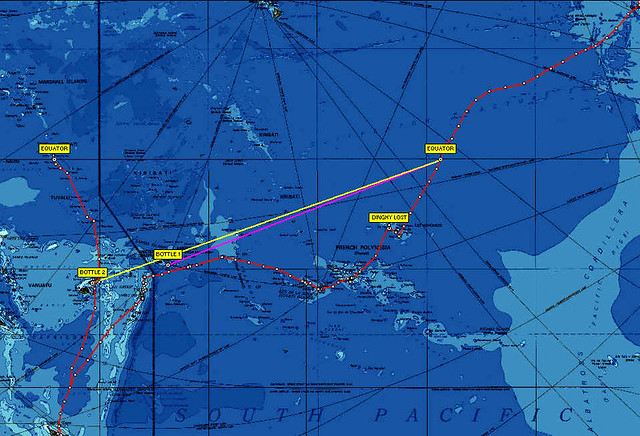
Navatu Bay : Bottle 2 destination - 3000 Miles and ended up 15 miles away from our entrance track

bottlemap
Our track vs the two recovered bottles

As we were getting ready for our 5 year sailing trip, we decided to have a party to say goodbye to all of our friends and family. The boat was very full and we were slightly afraid of the “helpful” gifts we might receive from the guests, so we stole an idea from our friends on Claire de Lune who had left earlier in the season. In lieu of gifts, it was suggested that guests bring a bottle of wine with their email and/or mailing address on the bottle. We  told them that we would email/mail them from the location we drank their bottle of wine and describe some of our adventures of the area. It is not much of a bribe but I guess there are a few people who want to live vicariously through other people's drinking habits, and we left Ventura CA with a full wine-bilge.

As we set out on the big puddle-jump between Puerto Vallarta Mexico and the Marquesas we decided to add a little bonus for our adventure starved friends. On April 12 at the equator (133° W)  we threw four wines bottles overboard with messages and our boat cards wrapped inside ziplock bags into the great blue ocean to see what would happen. We continued across the South Pacific on the traditional coconut milk run route (the northern version) and ended up in New Zealand in November 2004, having traveled over 9000 nautical miles since our going away party the year before.

In early January we received an email from a woman in Auasi, American Samoa whose son had found one of our bottles on the beach on Dec 31, 2004. She said the message was unreadable, but our boat card helped guide her to us. Our bottle had traveled 2400 nautical  miles during our passage and ended up within 50 miles of our track between Suwarrow in the Cook Islands and Nuiatoputapu in Tonga.

We spent the rest of cyclone season enjoying the land travel in New Zealand covering almost the same distance as our pacific crossing, before we headed back to the tropics to Savusavu Fiji in May, 2005. We spent most of our time in Fiji off the beaten track, cruising the eastern side of Fiji to the Lau group, Budd Reef and the Northern side of Vanua Levu and did not see more than four other boats the entire time. We were very much looking forward to stocking up on some fresh produce when we arrived in Labasa Fiji, where we checked our email and were amazed to find that another one of our bottles had been found. This one was found in May 2005 and on the island of  Navatu in Fiji. It took us awhile but we finally located the island; it was only 15 miles from where we entered the reef in Savusavu!! We changed our plans and continued our trip around Vanua Levu and pulled into the anchorage at Navatu only to find out that the young man actually lived in Suva but was visiting his Great Aunt when he found the bottle. It was still interesting to see the village, meet his aunt and converge on the same path that our bottle had taken from over 3000 miles away.

For the cyclone season this year we are heading to the Marshall islands. We’ve really enjoyed the leisurely cruising through Tuvalu and Kirabati and yesterday, November 12, 2005, we once again found ourselves crossing the equator (this time at 173.5° E). Four more bottles entered the strong westerly setting Equatorial current and it will be VERY interesting to see where they end up. I am still amazed that two out of the four original bottles were found in one piece. When you look at the expanse of the pacific as you sail across it, then explore the remote unpopulated beaches and watch the surf  pound on the windward reefs, I can’t imagine what the odds makers in Vegas would do. If only we had put a message in our dinghy before it drifted out to sea forever from Ua Pou in the Marquesas, or better yet bought a lottery ticket along the way.

Baulailai Bay

Baulailai Bay (August 17th – 22nd )
 16°44.88' S 178°29.02' E


Baulailai Bay
As much as we enjoyed our visits on the north side of Vanua Levu, there is something to be said for time alone!  After leaving Naviqiri we decided to anchor at Baulailai Bay, largely because there was no village.  We had the bay to ourselves and were enjoying some of the down time.  We did have a few visitors drop by, locals from neighboring villages who were out fishing.  We got a good shock when one fishing boat came by and yelled out "Bula Chris!  Where's KT?".  "You know me?" asked Chris.  Turns out they were from a neighboring village to Naviqiri and had hear about us through the 'coconut network' (what we've tagged the amazing gossip trail that seems to exist from one village to the next, even without phones).   We also learned that deep into the mangroves of Baulailai Bay is an Indian Village of about 5 houses.  One of the residents stopped by to say hello and we traded some banana bread for fresh oragnes.  Other than that it was quite quiet and we spent time reading and relaxing.  There was also a bit of weather that came through so we ended up staying  four nights while we waited for the rain and wind to pass by.

We left Baulailai Bay on the 21st, and spent the night at Salevu Bay.


Also Island to Navaqiri Village: It's all about the People

Current Location: Baulailai Bay
Current Position: 16°44.88' S 178°29.02' E
Next Destination: Bua Bay


It is impossible to find the words to describe our recent experiences …they are unlike anything we've ever imagined and it is all due to the wonderful natives of Fiji. These people have opened our eyes and hearts to way of living that we can only hope to keep with us when we (someday) return to America.

As we prefer to keep the BLOGs short (and since we are four weeks behind), we'll save the details for a future website update and just give you a brief summary in the BLOG (guess you'll just have to wait for the really good stuff!).


\


MALAU POINT / LABASA

Our next extended stay was three nights at Malau Point which provided bus access to the "big city" of Labasa. As with the States it seems that large cities change everything … we could quickly feel the good moods of weeks past draining away as we battled traffic, noise, trash, and some less friendly Fijians. On the bright side we were ecstatic about hitting an internet café and browsing the HUGE fresh veggie market. Meat and Veggies at last!!!

ULUIVAWANI

We truly lucked at when we landed here … After leaving Malau Point we spent a windy night anchored at Nukubati Bay, so windy that the following morning (now August 1st) we picked up anchor and went looking for a more protected spot. Uluivawani is not listed on the charts as an anchorage, but as we motored by we noticed how calm it was and thought the sandy beach looked like an added bonus.

There were only two houses ashore, so we weren't sure what to expect when we went ashore with Shadowfax (who we'd been traveling with this entire time). What we found was one of the nicest couples we've met (Ben and Nie) who live with their father and work/farm the surrounding land.

Ben and Nie took us on an amazing hike, to the top of rocks overlooking the bay, with a beautiful view that still sits in the forefront of my memory. They offered us food & tea and opened their home to us without a second thought. In return (although they wanted & expected nothing) we offered to cook them dinner and held a potluck at their house. We aren't sure if they really liked our Palongi dishes, but they would never say otherwise (we did noticed they seemed to take extra rice!).
We only stayed two nights and when we went in to say goodbye and thank-you, they sent us back to our boats with so much food (coconuts, kasava, bananas) that we nearly sunk the dinghy!

NAURORE (NAVIQIRI VILLAGE)


If the last two months in Fiji hadn't yet convinced us that there is something quite special about the Fijian People & their culture, Naviqiri Village alone would've done so! It is with tears in my eyes that I think about Naviqiri and what to write, as it was just today that we departed after a two week stay. We can't believe it was only two weeks, it felt like at least a month, and the people touched something special within Chris and I.

We shared meals … everywhere we went lunch or tea was offered. We had a few visitors on Billabong for tea & snacks, and one couple out for dinner (who later reported to her sister that the food was "like in the magazines"!!!). It also seemed that we were beckoned into way too many grog (kava) parties - it is just impossible to say no! A couple of the days we brought in some special treats, attempting to make enough for the entire village - it was quite the mob scene as we handed out cakes,
cookies and lollies (they sure do love sweets!).

We shared games … Chris nearly killed himself playing rugby with both the kids and adults, but there is no doubt that sports can unite where language might fail, and no matter how old he might feel the next morning (or same evening) he played just about every afternoon. I stuck to Frisbee (which we introduced them to), volleyball and children games (jump rope, three legged races, wheel barrel races, leap frog, and duck-duck goose). It got so the children (and I think some of the adults too) would come looking for us after school … I think we spent EVERY afternoon of our two weeks hanging out and playing, staying until the very last bit of light left the sky!

We shared crafts and work … Chris pulled his back helping a few of the men build a house, while I gained a sore bum sitting on hard floors discovering that weaving & broom making take a lot of time and patience! We learned the process of coconut oil making and yaquona drying (for kava). I shared some of my cross-stitches (just to prove that Palongi's can be creative too!).

As with most the South Pacific, they LOVE getting their pictures taken and looking at the resulting photo on the LCD screen. It seemed they were even more enthusiastic then most we'd come across. If we had had enough paper and ink (and time) we would have tried to print a copy for everyone; instead we put together a visitor's book for them, including five color collage prints of photos we had taken during our visit. I was first amazed at the elegant words Chris used when he presented our
loloma (gift) to the village (during Church service), and then even more amazed with the smiles and tears of the villagers as they crowded around the book later in the day, pointing and laughing at the various pictures.

We also enjoyed some terrific walking/hiking. The views were outstanding, and we were always accompanied by a local or two which made it all the more enjoyable. It felt as though we truly got to know many of the villagers and they got to know us. It seemed there was never enough time in a day and the two weeks went quickly. We said our goodbyes (on August 16th), stopping by each house (nearly 40 of them) to give handshakes, hugs, and Vinaka Vakalevu's (Thank you very much's). We had become especially good friends with Sera, Fredie and their family. Even Fredie (and just about Chris) shed tears as we said goodbye. Grandma (as we call her) hugged me so tight I thought I might
pass out!

As we motored out of the bay, they flashed us using the sun's reflection off of mirrors (we of course flashed back) … and kept flashing … and kept flashing … and kept flashing … I kid you not, it went on for a good 30 minutes while we got farther and farther away. Already I am looking forward to our return …

Naurore & Naviqiri Village

Naurore and Naviqiri Village (August 3rd – 17th)


Arrival

The bay of Naurore was dotted with locals fishing with hand lines from bamboo rafts.  We had barely set the anchor when a couple of these bamboo rafts started making their way towards us.  “BULA! BULA!”, yelled out two women from one of the rafts as they neared Billabong.  “BULA!”, we smiled back.  As the raft bumped up against our transom step one of the ladies (Sio) hopped aboard.  While we think the Fijian’s openness and sharing is terrific, it is sometimes hard for us to get used to this “open door policy”.  We have to remind ourselves that in their culture visiting one another, entering other’s homes, does not always require an invitation (or knocking), people come and go as they please.  It’s something that we’d have to adjust to over the next two weeks in Naviqiri.  We helped Sera (the other lady) tie up the raft and come aboard.  A few minutes later another bamboo raft appeared and Luke joined us as well.  I was beginning to think it was going to be a downright party when I noticed a few more rafts paddling towards Billabong, but our guests yelled out a few words in Fijian and the rafts headed for Shadowfax instead.  Sio was one of the more pushy and grabby Fijians we’ve met; just picking up anything and everything in the cockpit and eventually putting on Chris’s reef walkers (we're pretty sure she would've walked away with them if we hadn't said something when she left!).


Luke didn’t seem to speak much English but had a terrific (mostly toothless) smile and seemed to just enjoy hanging in the cockpit.  Sera was more reserved but quite curious about us.  She asked all kinds of questions about our boat, where we’d been in Fiji, and especially about Chris and I and our relationship.  In most of the South Pacific Islands that we have visited, including Fiji, we’ve found it easier to just let people assume we’re married … this fits in better with some of the conservative cultures and saves us from any lengthy explanations.  However, we didn’t really go out of the way to tell people this, we just didn’t correct people when they referred to our husband or wife.  Sera however was so curious that it was becoming difficult to be sly.  Hating to lie, I tried a number of avoidance tactics; when she asked me how long Chris and I had been married, I replied, “Oh, Chris and I have been together for 3 years.”  When she asked when [date] we got married, I ignored the question and asked, “When did you get married?”.  We went round about like this for a few more minutes before I finally caved and starting making stuff up.

At this point Chris was forward with our other two guests, so I was talking loudly to ensure we’d be on the same page should he be asked anything later on.  By the time Sera was finished with me, we had married in Nov 2002, at a lovely beach ceremony with all our friends and family.  I was lucky that she didn’t ask for photos!!!  I was getting some weird side glances from Chris as he was talking to Sio & Luke (and overhearing me), but he was smart enough not to question anything.  I learned that Sera had been married for nine years, and while she wants children has yet to have any (not by choice).  Hearing this and knowing what children mean in the Fijian culture my heart went out to her.

We had a good visit with our new friends before they headed out for more fishing and we cleaned up for our Sevusevu with the chief.

Welcome

When we first came ashore just outside the village things seemed a bit dicey.  A young man was standing on the beach watching us approach.  uncharacteristic to Fijians, he was not smiling or yelling out Bula.  As the four of us clamored out of the dinghy and cheerfully said BULA, he still didn’t smile or talk.


Turaga ni Koro: The village spokesman.  Unlike the chief (who inherits the position), the Turaga ni Koro is voted into position by the villagers.  Typically, any business with the chief is conducted through or in coordination with the spokesman (i.e. it would be inappropriate for us to just show up at the chief's house without the Turaga ni Koro or someone of equivalent standing).

And he still said nothing when we asked if he knew where the Turaga ni Koro lived. Uh oh we thought, what kind of village is this?  We weren’t to sure what to do, a visitor should not just enter the village on their own, they should be guided/escorted, at least until the Sevusevu has been accepted.  Down the beach a bit were three young men, so not having much luck with our current local, we yelled out to them and asked if they knew where the Turaga ni Koro was.  One of them finally came forward and said he would lead us to him.  Phew!  Of course by now we were completely confused about what we would find in the village; on one hand we had a great greeting from the fishermen, but on the other hand, these young men didn’t seem to really want anything to do with us.  Well, we later discovered that the first young man, Sakioso, was mentally slow and quite shy ... basically he didn't know what to make of these white people coming ashore!  By the end of our visit he would be talking up a storm (mostly in Fijian) and smiling whenever we came near.  The other three young men were actually from a different village, and the Turaga ni Koro was away from the village, so these young men weren't sure where to take us!  It all made sense afterwards, but sure was awkward in the moment!

Any feelings of doubt were swept away the minute we entered the village.  It was truly a mob scene. Everyone came out to greet us and within seconds we were surrounded.  Hands were thrust, names exchanged, and smiles shared.  I swear I actually saw a few women running down the path to meet us!  You’d be shaking one hand while another person tapped you on your right shoulder, just as you turned to shake their hand, someone else would tap your left shoulder, as so it went.  It seemed like it took hours just to walk a few feet.  We felt famous, like rock stars, surrounded by people who just wanted a glimpse of us, and if lucky an autograph (or in this case a hand shake).  It is so hard to comprehend, because who are we to warrant so much attention? … I mean really, we’re nobody, just a couple of white people on “vacation”.  But in these out of the way places we are unique, we are different, we are truly from another world – they are honored that we would want to visit their village, their home, of all places.  And so we moved along, until we were ushered into one of the homes.  Even has we were sitting people streamed in to present their hands to us and introduce themselves.  Others gathered at the doorway to watch.  Chris & Karl started to put their yaqona out, when I whispered to Chris, “so who’s the chief?”.  He didn’t know.  Neither did Karl or Julie.  Finally Chris asked, and that’s when we learned that this wasn’t the chief’s house, it was just a grog party … it didn’t matter that they’d just met us, we were invited!  “We, ‘er, have to go to the chief’s house” we said.  “Stay and have some grog”, they told us.  But when we asked if that was ‘allowed’ before we had done our Sevusevu, they promptly nominated someone to lead us to the chief’s house, making us promise we'd come back afterwards.

The chief isn’t able to get out of bed much due to severe arthritis in his knees.  After shaking hands and introductions we sat on the floor while he propped himself up in his bed.  He performed the chants/prayers for the yaqona and introduced us to Elia who then took us on a tour of the village.  If we had missed anyone on the way into the village, we met them now.  The village has 41 houses, although somewhere between 5 – 10 of those houses are not currently lived in (their owners typically residing/working in Labasa or Suva).  After our tour we returned to the grog party which was taking place in Seraia’s house.  Not that we like grog much, but a promise is a promise.  We donated some pre-ground Waka (kava) to the cause and spent over an hour kicking it on the floor with a huge group of people.

The next morning (Thursday) we were surprised when a few of the villagers arrived at Billabong to check us & the boat out.  They excitedly came aboard and stayed, visiting for a couple of hours.  After their visit we went ashore with Shadowfax and met up with Sera and Seraia who guided us on walk.  The scenery was beautiful and we enjoyed getting to know our ‘guides’.  Along the way we ran into the Turaga ni Koro, who, as it turns out, is Sera’s brother.  It is interesting to get to know the family relations within the village, you soon discover that although not obvious, there is a definite pecking order.  Everyone appears to help anyone, and on the whole the village runs as a terrific sharing community, but it is not without ‘political’ undercurrents.  After our walk, which took us up where we could view the neighboring bays and then around past the school, we relaxed under a huge tree, joined by other locals.  Chris excitedly waiting for the touch Rugby game to start (which they play every afternoon around four).

Playtime

Afternoon play time became a daily must for us.  It was the easiest place to relax and goof off with the locals, especially the children.  No matter how sore or run down Chris played touch rugby with the men everyday.  In between taking video and pictures, I played games with the children.  Learning a few of their games, as well as teaching them some of our own.  During one of the rugby games I taught a few of the kids a fight song (Lean to left, lean to the right, stand up, sit down, fight-fight-fight) and The Wave.  The wave was especially interesting, because while they did what I told them, I could tell they didn’t get it!  I tried to explain to one of the older children (who spoke better English), but, …. well you can just imagine how silly & pointless the wave must seem, especially to someone who hasn’t every seen or been to a large scale sporting event!  We also brought in a Frisbee,  which everyone from the two year olds to the fifty year olds tossed around.  Chris would get them laughing with his behind the back and under the leg throws.  The children loved when he’d tell them to “go long” … even after two weeks they never ran far enough.  A few of the men would attempt a long throw after seeing Chris, getting laughs all around when the Frisbee went straight into the dirt!  By our second week there they had also gotten out a volleyball net which they hoisted between two wooden branches stuck in the ground.  They weren’t big on form, but it was huge amounts of fun and they were great at keeping a volley going.  Saturday’s were especially fun because all the local children who boarded at the nearby school came home for the weekend.  It was hard to keep up with all the activity, we’d return to the boat after dark, hot, dirty and exhausted … but it in our two weeks at Naviqiri we didn’t miss a single afternoon!

School

During our walk with Sera & Seraia, the school headmaster (principal) had invited us back on Friday.  So Friday morning, escorted by Sera and two younger children, we headed out for the school.  Although this school was also a boarding school, it was much smaller than Cawaro’s.  They gathered all the children in one room, and we introduced ourselves … giving the same type of spill that we had in Cawaro.  We got the same sort of questions from the children, although we were once again caught of guard by one little boy’s question.  He asked, “Our you still fighting with Iraq?”.  Living on boats, usually in the middle of nowhere, we aren’t up-to-date on current events, and so Chris responded, “You tell me, are we?”  We were even more surprised when a bit later, after one of the children had asked us what religion we were, the teacher mentioned that he was Muslim, and then said, “You must hate all Muslims.”  It baffles me that he could think that … even more so it saddens me, because America (as a whole) does seem to find a way to make a lot of things racial.  I don’t get it, and we strongly explained that no, we don’t hate all Muslims or any Muslims, we can only blame the specific people for their acts, not an entire culture or religion.

After class, our host (the Muslim teacher), Kamal, and his wife, Rafiza, invited us over to their house for refreshments.  They live in a temporary house provided by the school (their ‘real’ home is in Labasa) with their two year old daughter (Zeenia) and Kamal's mother (Kariman).  A few days later we also had dinner at their house, with his sister & her two children in attendance.  When we arrived, hundred’s of curious eyes peered out at us from the dorms, and as we sat in Kamal's house we could see a number of children gathered outside looking in, trying to get a glimpse of the Palagi’s!  Fijian Indians make up over 40% of Fiji’s population, and until dinner with Kamal & his family, we had not had much of a chance to learn about some of the different beliefs and traditions of the Indian population.  It was an intriguing new experience for us.  Apparently Zeenia likes to watch the video of her parent's wedding, and so we too watched along, learning quite a bit about arranged Muslim weddings.  As both Kamal & Rafiza are teachers, we also talked a lot about the education system and the skill levels of the children.  And we were thrilled when they served us tasty Indian dishes … Curry & Roti’s … it doesn’t get any better than that!

Food

We had quite a few interesting eating experiences in the village.  It seemed that every time we turned around someone was offering us something to eat or drink.  Tea is HUGE in Fiji.  Typically black tea, with lots and lots of sugar.  It takes a bit of getting used to; to drink a steaming hot cup of liquid when you are already sweating profusely!  We actually preferred the lemon leaf tea, which was a bit ironic since they would apologize to us for only serving the lemon leaf tea whenever they were out of black tea.  Since the black tea cost money, it is considered the fancier and more appropriate tea, especially for white guests.  I came in early enough one morning to watch Grandma & Little Freddie eating breakfast … on the menu was cooked rice drowned in tea – eaten like a bowl of cereal.  They also love breaking up breakfast crackers (a plain thick white cracker) into their cup of tea.

Cooked taro leaves served in coconut milk or mixed with a can of tuna is also popular.  With exception that it is a bit soggy, it is probably one of the easiest things to get down (from a Palagi's point of view).  When Sera served us lunch of taro mixed with tuna and cassava, we felt a twinge a guilt knowing that she had purchased the tuna especially for us.  In most villages they live mainly off of what they can grow or catch, spending little or no money.  Many of the villagers do not work on a regular basis, but rather a day here and there as needed to make a few dollars.  For a full days work, the average Fijian makes about $10 F a day (that’s about $6.00 US)!  And still, they continue to give, no matter how little they might have.

Sunday lunch (after church) is a big event as well.  This is probably their fanciest meal of the week, and when they are most likely to use more valued food products (like fish or store bought items).  You will always be invited for a Sunday meal at someone’s home.  Of course cassava and taro leaves are still the main staples, but you are also likely to get fresh fish or octopus cooked in coconut milk.  I wasn’t brave enough to go for the octopus, it just looked to much like … well, like an octopus!  Chris did, and found it a bit chewy.  It was really quite funny when he was trying to get some down and looked over and saw a little boy sucking down octopus tentacles just like spaghetti.  The little boy had a couple of tentacles, with suction cups and all, hanging out of his mouth and slapping against his cheeks as he sucked them in.  At any minute you expected the suction cups to adhere to his cheeks!

It was during one of these Sunday lunches that we discovered cassava is best smothered in lime juice and salt, although still far from good!  It was also when we learned that the plate you are given (usually there is a dinner sized plate, along with a bowl) is used just for cassava (everything else goes into the bowl).  Our plates looked a little silly with the measly amount of cassava we usually took.  The Fijian’s on the other hand loaded their plates full with mounds of cassava.   One afternoon even the preacher made fun of us, when he said, showing us two of his fingers, “Palogi’s think this is enough cassava!”.

With all the food that was being handed out, we wanted to give something back.  One Saturday I spent the morning making papaya cakes (my favorite use of papaya) with lemon frosting.  We cut the cakes into small pieces and took it, along with lollies into the village.  We created quite the mob scene once word got around.  I think we managed to give every adult some cake, and every child a lollie pop!  We were sure popular after that!  The following Saturday, Chris noticed all the villagers out fishing on their bamboo rafts.  He hopped in the dinghy to fish as well.  He caught a large Wahoo (a really good fish), and after cleaning it, gave a piece to everyone who was out fishing, as well as a piece to the Chief & Minister.  We also had Fred & Sera out to our boat for dinner.  I served leftover Chinese Chicken Salad along with Papaya Curry w/ rice.  I guess it was a big hit because Sera later told her sister that the food was “like in the magazines”!  Fred really like the flavored tea I served after dinner, and so before we departed I left them with a few bags of their own.

And we can’t forget about Koko.  The first (and probably last) live chicken that I bought!  On our first Sunday in Naviqiri we went with the Minister into a nearby settlement for church & lunch.  Later, when we were sitting around (the men and some women drinking grog), we learned that one of the ladies sold chickens ($10).  Not having a freezer, we hadn’t had fresh meat in some time, so chicken was sounding pretty good.  Julie (Shadowfax) and I spent a good deal of time ensuring that I would be no part of the killing or cleaning of the chicken.  That the chicken would be ‘delivered’ fully dead, with no head, feet, feathers, or guts.  No problem.  Since we didn’t want to eat the chicken right away, and since the settlement was a bit of a drive from Naviqiri, Seraia said she would take care of the chicken in Naviqiri until we were ready for it.  The lady went off to fetch the chicken and a few minutes later she called over to me as she lifted a (live) hen up and then threw it into the back of the truck.  When it came time for us to leave, there was this hen, sitting in the middle of the back of the truck, staring out at us; and boy did she looked pissed!  Eight of us crawled into the back along with the chicken for the bumpy ride back.  The poor thing was bouncing and sliding all over the place!  At some point along the way I decided I needed to name it (I don’t know why).  I thought I was being clever when I named it Koko.  I was thinking that the Fijian word for food was kokona, however I realized a bit later that food is really kakana … but naming my chicken Kaka just didn’t sound good, so we stayed with Koko.  The locals got a kick out of the Palagi’s and their chicken Koko.  I’m quite sure they don’t bother naming their chickens!  About four days later I decided we were ready for Koko.  Chris was walking to Sera’s house to pick up his shoes for rugby when he past Koko stealing coconut from between the paws of a dog.  “Koko?” he asked Seraia, who was standing nearby.  “Io” (yes), she said.  Just a few minutes later he is walking back to the rugby field when he sees Seraia holding a headless chicken by its legs dunking it in and out of boiling water.  “Uh, Koko?” he asked.  “Io.”  The next day, more than one person in the village asked me, “How was Koko?”.  I’m sure they were thinking, crazy chicken-naming Palagi!  Koko did spark an interesting conversation between Sera and I, as I tried to explain that the majority of Americans did not grow their own food, that we had huge grocery markets where we purchased everything from vegetables and fruits to meats.  And because of this I had never owned, killed, or cleaned a chicken, rather I had always purchased them from a store.  She found this quite interesting.

In addition to all the food, there was a lot of grog (kava).  It seemed every time we walked passed a house we heard, "Come in, Come in ... have a bowl ... just one bowl!".  It is so hard to say no to them, even if grog tastes like dirty water!  Some of the grog parties were more formal, served in celebration or as part of an event or even fundraisers.  Other times, it was enjoyed much as one might enjoy a cold beer at the end of a working day ... only it seemed many of the villagers partook in grog at any hour.

Hikes 

Eating all this food, we really needed some exercise!  Besides our first walk with Sera & Sereia, we went for two other significant hikes.  One was up to a point known as Monkey Face.  Most of the walk was along a dry dirt (hot) road.  The walk took us to the fields where the locals were planting pine trees.  As we neared we could hear them calling out to us; “Hey … Hey!”.  An extremely steep incline took us up to a point that offered outstanding views and looked over the work the locals were doing.  It took about one minute before all the workers came up to say hi.  Many of the workers were from the neighboring village, but some were also from Naviqiri.  Although you’d think we’d be getting used to it, we were amazed that these people would want to meet us, that they would come out and greet us.  We once again got that crazy Palagi look when we turned down their offer for a ride back to the village, explaining that we wanted to enjoy the view and get some exercise.  After all, they pretty much get the view everyday, and between working the fields and walking everywhere, they get plenty of exercise … who would want to walk just to walk?

The following day Sera and Freddie took us in the opposite direction to Sera’s brother’s bush house.  A small thatched hut he uses when he’s working his land.  More terrific views, and wonderful company.  We could spend days exploring the lands surrounding Naviqiri!

Work, Crafts, and Culture

When we weren’t hiking, playing, or eating, we tried to further ingrain ourselves into their culture by spending time in the village, doing whatever the locals were doing, or just hanging out.

Chris spent part of a day helping some of the men build a traditional Fijian house.  Unfortunately he pulled his back doing so, but he didn’t seem to mind – he was just happy that he could help out.  The men he helped were quite surprised when Chris showed up, picked up a shovel and starting digging!  And they were thrilled when I came by to take everyone’s picture.  When the house was finished, they made sure to find Chris and tell him to come look.

He spent another morning taking a few of the locals out fishing in the dinghy (he was known as quite the fisherman after his wahoo catch).  Unfortunately we were almost out of fuel so he couldn’t fish too long, but they were able to catch a couple of decent sized fish and everyone came away smiling.

I’m sure Chris stirred up some waves when he came in with me to do laundry.  Naviqiri has a really good water source, so we asked permission to bring in some of our savasava (washing).  Whenever we have a few huge piles (such was the case) Chris helps me, usually scrubbing or wringing.  We set ourselves up near the tap, and the women’s jaws just about hit the floor when Chris actually started scrubbing laundry.  A couple of women kept trying to offer to help and a few tried to actually pull Chris away from the laundry.  But we stuck to our guns and soon a few of the women were actually pointing out Chris to some of the men, and later told me, “Yes, I think it’s good the men help with laundry!”  In typical Fijian fashion, no matter how much we said no we couldn’t keep them from helping us, pretty soon Sera just ignored me and sat down and started scrubbing.  I’m not complaining, with their help it was one of the fastest hand washings I’ve ever done!

I spent one evening helping a group of women process voivoi.  After Pandanus leaves (a tree that reminds me of something from a Dr. Seuss book) are stripped of any spiny edges and dried, they are rolled and pounded (to help make them flat and flexible).  These dried leaves are known as voivoi.  One group of women take the long pieces of voivoi, and tightly wrap them around their hands.  These are thrown into a pile where another group of women unroll them, and bundle a bunch of them together.  The bundles are then pounded with a heavy club.  They spend hours doing this in order to get enough material for basket & mat weaving.  Within the first thirty minutes of rolling voivoi (my job), my hands were aching and my butt was numb (from sitting on the floor).  I managed to stay for a couple of hours, all the while becoming more and more impressed with their patience and strength.

A few days later I found myself once again sitting on a mat, this time using a knife to strip off the green leafy part from the individual strands of a coconut palm.  Once peeled you are left with the straight, stiff center.  Fasten enough of these together and you now have a broom.  When I first saw these brooms I wasn’t overly impressed.  After an entire day of helping; fingers and butt becoming sore, I realized just how much work went into their creation.  Sera was nice enough to give me one of the brooms we made.  Of course after all that work I can’t every imagine actually using the broom, God forbid it should get ruined!

The best part of these days was talking with the locals.  As I sat with Sera and Grandma making brooms (we tended to call the woman elders in Sera & Freddie's family Grandma), Sera and I discussed the different ways of Fijians and Americans.  When I asked how they decided where to build their house, the answer was obvious, their house was close to both her mother’s  and Freddie’s (her husband) mother’s house.  This way they could help take care of them as they got older.  Of course she wanted to know what happens with the ‘elders’ in America.  She was especially interested because it seemed so strange to her (and everyone) when we initially explained how far away Chris lived from his parents (and that this distance was common for a lot of families).  They had no idea that the two coasts of America were over 3,000 miles apart!   I found it difficult explaining elder homes / care centers to someone from a culture where the family unit fully looks after each other, where family values are so deeply ingrained.

It was just a few days prior when somehow the topic of homeless people had come up with another local, who was visiting us aboard Billabong.  I doubt I’ll ever forget the confused look on his face as he asked, “Where are their families?” ... he couldn't even comprehend the idea of someone living without a home, because of course their family would take care of them.  Chris and I didn’t have an answer.

Some conversations were quite humorous.  One day we were talking about coconuts; Chris is really into his coconut trees, amazed by the whole process, the different types of coconuts, and their various uses.  It seems he’s always asking questions and coconut hunting.  While discussing coconuts with a few of the locals, he happened to mention that prior to cruising he’d never really realized what a real coconut looked like (with husk and all, not just the round brown-black ball w/ ‘eyes’).  You should’ve seen all the weird looks he got, how could anyone not know what a coconut looks like?  Of course we then felt obligated to explain that in America coconut trees didn’t just grow in abundance, and in fact there are actually places where people plant the tree for decoration, rather then food!!!  There was quite a bit of laughter at that one!

I spent a lot of my village time trying to learn a few Fijian words.  I discovered I can do about two words a day, as long as I keep using them in a sentence.  Everyone in the village loved it when any of the Palagi’s would use a Fijian word.  They not only got a good laugh (which wasn’t entirely encouraging when you’re the one trying to get it right!), but also thought it was special and respectful that we were trying so hard.  The only problem with saying anything in Fijian, is that the Grandma’s and the smaller children seemed to think that meant you spoke fluent Fijian, and the next thing I knew they’d be talking a mile a minute to me (in Fijian), while I just smiled and said “Io” (yes) a lot!  Luckily I never agreed to anything that got me in trouble!!!  Sera knew I was trying to learn new words, so she would tell me the Fijian word for objects all the time.  One day we were sitting around in her house (having a rest, as they like to say), and Little Freddie brought me a pillow.  Sera says to me (or at least what I heard was), “Fijians are Loco-loco”.  I was dumbfounded for a good minute, is she really telling me Fijians are crazy?  After some stammering and repeating, I finally figured out she was telling me that in Fijian pillow is locoloco.  I then just had to explain why I was so confused, I told her that in Spanish the word loco means crazy and that I thought she was telling me they were crazy!  She had a good laugh, and when I came into the village the next day it seemed EVERYONE in the village knew about the Loco loco Fijians!

We also tried to visit Vani, Sera's sister, everyday.  Vani is only twenty-three and has spent the last seven years confined to bed.  Her family says she has arthritis and that is why she can't walk and can barely sit up, but after our first visit we think she more likely has something like M.S.  She has a brilliant, perfect smile and speaks outstanding English.  She's filled with energy and spirit despite her condition.  She looked forward to our daily visit and many times would write us notes, which her mother would deliver to us.  You really start to get a feel for the isolation of the village when talking to Vani and her family about her condition.  We learned that a doctor had been to see her ... seven years ago.  It sounds as if he basically diagnosed her with arthritis and then disappeared.  Vani is the only one in her village with this severe condition and prior to a cruising couple's visit the previous year she had thought she "was the only one in the world with this condition".  Due to lack of knowledge & medical facilities she is confined to bed 24 hours a day.  Our guess is that if she had access to decent medical she would probably be mobile, even if disabled.  We racked our brains for a way to build some type of wheel chair, but just didn't have the right materials.  We also weren't a hundred percent sure she would've every used the chair ... one Saturday we offered to move her out to the play field, where she could lay on a mat w/ pillows and visit with Julie and I while watching the games.  She didn't want to  ... talking with her later we determined she was part scared and part embarrassed, in her house & bed she at least felt 'safe'.

Goodbyes

With so much going on everyday it seemed like a blink of an eye and before we knew it two weeks had gone by.  Wanting to give something back to the village we racked our brains and decided on a photo/visitor's book.  Everyone in the village loved getting their photo taken, and then looking at the picture on the camera's viewfinder.  We couldn't possible print a picture for everyone, and fearing that we'd leave someone out, decided that a serious of collages would be best.  Chris then suggest we put the pictures into a three ringed binder, add paper, and turn it into a visitor's book that future cruisers could add to.  Chris presented the loloma (gift) to the village during Church.  After Church as we went around visiting with various families, Chris grabbed the book and walked it around the village to make sure they understood what it was.  People excitedly gathered around the book laughing and pointing at the pictures.  We had made a huge attempt to ensure that the majority of people were included, and from the smiling faces I think we were successful!

On Tuesday (August 16th) we went in with Shadowfax to say goodbye.  We walked to every house giving hugs and handshakes.  We then joined everyone for a final playtime before heading back to the boats.  There were quite a few tears and many solemn faces, this was a hard place to leave.  To make matters worse we also had to say goodbye to Shadowfax, our buddy boat for the last two months.  We hoped to hook up again with them on the west side of Fiji, but weren't sure of the timing, and if we missed them, then this would be our last goodbye.  Shadowfax would be returning to NZ, while we would be heading north towards the Marshall Islands.

Before leaving on Wednesday morning, Chris and I went in quickly to pick up a gift from Sera - she had woven us a small mat with Billabong woven in the center in black voivoi.  While visiting with Sera and her family, Shadowfax pulled anchor, sounding their air horn for a final goodbye.  We saw a lot of people coming out of their homes, waving shirts and rags into the air, tears flowing.  Many of them grabbed mirrors and used the sun to send reflected flashes out to Shadowfax.  Shortly after, Chris and I gave a few final hugs ... I practically had to man handled one of the Grandmas in order to get her to let go of me.  On the bright side, since we were heading to the Marshall's, we would be returning to Fiji the following year and we promised to visit Naviqiri again.  At this point everyone was telling us that we should build a home in their village, some place we could come and visit and bring our own families to ... they had just about picked the build site and Sera had already offered to take care of the house while we were away.  It is something that we are seriously thinking about!

As we pulled anchored, we too sounded our air horn.  We could see some people on the beach, so we frantically waved our own clothing into the air to say goodbye.  Chris got out a mirror and reflected signals back to the village.  It took us about two hours to get out of eye sight of Naviqiri Village, and during that entire two hours they were continuously reflecting the sun to us off of their mirrors ... and Chris right back to them.

We are unbelievable lucky to have had such a terrific experience ... I doubt they know how much they have influenced Chris and I.  I truly believe that they have sparked a positive change in Chris and I, and I only hope that we could hold onto that spark.

Uluivawani Journal

Uluivawani (known to us as Ben and Nie’s Place) (August 1st – 3rd)

Uluivawani 

Tired from the previous windy night and a long day of sailing, we didn’t head in that afternoon (now Monday, August 1st).  We were anchored in about 30 feet just off a reef that extended a few hundred feet from a terrific looking white sandy beach.  We could see two houses, but no sign of activity [people].

When we went ashore the next morning two young adults (so young and short I thought they were older children at first) greeted us on the beach.  Barely knowing our names they invited us to their home.  Over tea served with bread and butter we learned that they lived here along with Ben’s father (Big Ben).  We think that one of their uncles lives in the other house, but he wasn’t around.  They own and farm (copra to sell and other foods, such as cassava to eat) between 5 and 7 acres of beautiful land.  After tea we continued our talks sitting on a mat under a large tree watching the ocean.  Looking up at some precariously balanced boulders, Chris asked if it was possible to walk up there.  Ben immediately said he’d take us.

Off we went; Chris, Karl and Ben up in the front with Julie, Nie, and myself bringing up the rear.  First we hiked through the muddy banks of the mangroves.  Then over a couple of small rocks, and finally we started up.  The terrain was burnt down grass (they were getting ready to replant), but the hill (dare I say mountain) was quite steep.  Tired and thirsty, it was Chris yelling down “The view is worth it” that inspired the girls the rest of the way up.  And he didn’t lie … the view was spectacular.  We could see for miles; patches of turquoise (reefs) surrounded by deep blue.  360 degrees of inspirational views!  We continued along the ridge towards the boulders … Chris just had to get a look at how they were balanced.  Turns out they were barely touching – it’s amazing the top one hasn’t rolled down the cliff yet.  We came down the other side of the hill through coconut and lemon trees.  Chris and Ben - ‘being boys’ as they heaved into small boulders sending them ricocheting down the mountainside.  Ben picked us some lemons to take back to our boat, and as we’ve been experiencing with the Fijians, overdid himself.  We came away with more than a dozen lemons (per boat).  Although it was WAY more than we needed, we were quite excited about the prospect of Lemon Bars!

Back on the mat under the tree, Ben and Nie brought us small stalks of bananas and a number of oranges … we kept saying no more, and they kept it coming!  In return for everything, we asked them if there was anything we could do for them, anything they needed or work that we could assist with.  After a few “no’s”, they shyly said they would like yaqona for kava.  No problem!  This soon became an invitation for us to come drink grog with them … along with which they also said they’d prepare dinner.  Feeling they’d already out done themselves, we offered to bring in dinner instead.

A few hours into drinking grog (kava) we finally asked if we were ever going to actually eat … we didn’t want to be rude, but we were all starving and it was already past 8pm.  Luckily we were saved by Big Ben who isn’t much of a kava drinker, and therefore wanted to eat as well.  Apparently Fijians don’t like to eat too much (or at all) when drinking kava, because the food is too filling (not leaving room for the kava).  Ben and Nie continued to drink grog while the five us had dinner.  Big Ben was very pleasant to talk to, he was quite up to date on current affairs and spoke terrific English.
Biso - Bowl made from a coconut half that has been shaved out (and sometimes polished).  Used for drinking kava.
After dinner we had a departing biso of kava and returned to our boats.  The next day we learned the Ben and Nie drank grog until one in the morning and then finally ate!  Phew, glad we asked to eat!!  We asked them how they like the “Palagi Food” … it’s hard to get a straight answer because a Fijian will practically never say something rude to a guest, but we got the impression that it might have been too “different” for their taste!  They did however like the printed photograph of Ben and Nie that Chris and I gave them!

When we came in to say goodbye, they piled mounds of food upon us.  We didn’t ask for it … actually told them it was too much … but they just smiled and continued to disappear into the bush returning with coconuts, papayas, cassava, and bananas.  It was an unbelievable amount of food and we really had no clue what to do with it all.  We also got a bit of insight into one of the reasons cassava is so popular … it is tremendously easy to plant and grow.  We watched Big Ben has he took the long stem from an old cassava plant, cut the thin stalk into a number of pieces, and then just stuck them into the ground.  The stalk will then grow the cassava root (underground), and in 11 months they uproot the new cassava and use the bush to plant more.  They don’t have to maintain the bush or worry about feeding and watering it.  It’s pretty much self sufficient.  It didn’t make me like the taste of cassava any better, but I could at least understand why they ate so much of it!

As if the hospitality and food wasn’t enough, Nie also gave Julie and I a sulu.  I still can’t get over it … we had known them only for one day, had stayed in “their” bay for only two nights, and here they were treating us like old friends.