Bayram Cigerli Blog

Bigger İnfo Center and Archive
  • Herşey Dahil Sadece 350 Tl'ye Web Site Sahibi Ol

    Hızlı ve kolay bir şekilde sende web site sahibi olmak istiyorsan tek yapman gereken sitenin aşağısında bulunan iletişim formu üzerinden gerekli bilgileri girmen. Hepsi bu kadar.

  • Web Siteye Reklam Ver

    Sende web sitemize reklam vermek veya ilan vermek istiyorsan. Tek yapman gereken sitenin en altında bulunan yere iletişim bilgilerini girmen yeterli olacaktır. Ekip arkadaşlarımız siziznle iletişime gececektir.

  • Web Sitemizin Yazarı Editörü OL

    Sende kalemine güveniyorsan web sitemizde bir şeyler paylaşmak yazmak istiyorsan siteinin en aşağısında bulunan iletişim formunu kullanarak bizimle iletişime gecebilirisni

An Engagement in the British Branch of the Prussian Royal Family


In The Telegraph of Monday, 27 July 2020, the engagement was announced between Frederick "Fritzi" von Preussen and Mathilda "Tilly" Johnson. The couple have been dating for several years. Fritzi von Preussen is a second cousin of Prince Georg Friedrich of Prussia, Head of the Royal House.

Embed from Getty Images

Embed from Getty Images

Embed from Getty Images

Prince Frederick Nicholas Stormont von Preussen was born at London on 11 June 1990. He is the son of Prince Frederick Nicholas von Preussen (b.1946) and his wife Victoria (b.1952; née Mancroft). Fritzi's paternal grandparents are Prince Friedrich of Prussia (1911-1966) and Lady Brigid Guinness (1920-1995). Fritzi's maternal grandparents are Stormont Mancroft, 2nd Baron Mancroft (1914-1987), and Diana Lloyd.

Mathilda Noel Johnson was born in 1989. She is the daughter of Mr Rupert Johnson and his wife Simonetta (née Barber).

Prince Frederick is a great-great grandson of German Emperor Wilhelm II (1859-1941). He is a great-great-great-great grandson of Queen Victoria.

A special thank you to Michael Rhodes of the Peerage News Blog for providing the details of the engagement!

NOBLE ENERGY'S BUYOUT - WHAT IT MEANS FOR CYPRUS' GAS

Cyprus Mail 27 July 2020

The dire financial condition of Noble was challenging its ability to proceed with the agreed development plan of Aphrodite

After taking over Noble Energy this week, Chevron will likely take its time in deciding what to do with the Aphrodite gas-field

By Charles Ellinas

Chevron agreed this week to acquire Noble Energy, mostly because of its shale oil and gas assets in the US, at a bargain price of close to $5billion – about 40 per cent of the value of the company at the start of the year. It will be an all-stock deal, equivalent to about 3 per cent of Chevron’s market value.

But Chevron is also interested in Noble’s East Med natural gas assets, which, in addition to Tamar and Leviathan in Israel, also include the Aphrodite gas-field in Cyprus’ EEZ.

Acquisition details

Chevron is the second largest US oil company, with global operations. The company is very keen to expand its US shale assets. Having failed to acquire Anadarko last year, that was the main driver behind this acquisition. Through this, it makes it possible for Chevron to expand shale presence in the oil-rich Permian Basin in Texas and the DJ Basin in Colorado, where it is targeting to maintain production of over 1million barrels/day through to 2040.

Given Noble’s debt, which Chevron inherits, the total cost of the deal is more than $13billion, but it is still a bargain. It still is a cost-effective opportunity for Chevron to acquire additional, low-cost, proved reserves and resources.

The benefit to the company is that Noble’s oil and gas profile fits well with Chevron’s, bringing with it international gas assets and rich, low-cost, shale assets, totaling about 2billion barrels of oil equivalent (boe). This constitutes a sizeable addition to the company’s 12billion boe reserves.

Chevron’s interest is not just in shale assets, but also in Noble’s East Med and Equatorial Guinea proven natural gas reserves. These help the company bring its emissions intensity factor down – emissions per boe – something that helps improve its ESG (environmental, social and governance) profile, a metric important to its investors.

But Chevron also has major oil and gas interests in Saudi Arabia, Iraq and Qatar. Last year it teamed up with QP to build an $8billion petrochemicals complex in Qatar, where it also wants to be part of the LNG expansion project. It remains to be seen how it can reconcile its newly acquired presence in Israel politically with these. When asked, Chevron’s CEO, Mike Wirth, said: “We are an honest broker, we are a commercial actor, not a political actor.”

Leaving aside the impact of Covid-19 in reducing gas production in Israel in 2020, both Tamar and Leviathan are highly profitable, with an assured long-term market in Israel, without the need for high capital investment.

Chevron, though, showed interest in the East Med earlier, especially Egypt, where it has been present since 1937. In addition, Egypt’s Petroleum Minister, Tareq El Molla, was previously the head of Chevron-Egypt. End of 2019 and early this year it acquired exploration rights to three Egyptian blocks, in the Red Sea and the Med. It will also inherit Noble’s rights to two Shell-operated blocks in the Med. As a result, its longer-term presence in the region is assured and this acquisition, in effect, strengthens it.

However, the priority for Chevron now is to integrate Noble into its operations, and particularly its shale assets. So the East Med and Cyprus may need to be patient.

Impact on Aphrodite

Given its priorities, it remains to be seen how Chevron deals with Aphrodite. I think it will take its time before it decides.

In one sense, this acquisition overcomes the problems I raised in my article in the Cyprus Mail on Aphrodite on June 21. The dire financial condition of Noble was challenging its ability to proceed with the agreed development plan of the gas-field.

The reason Noble was forced to accept Chevron’s offer is that it has a high debt, over $8billion, with a debt-to-capital ratio of 164 per cent. Usually, the debt should not exceed 40 per cent of equity and the company has exceeded it significantly. Importantly, higher debt liabilities not only pose a risk, but also limit the company’s ability to borrow and invest in new projects.

In addition, Noble’s partner in Aphrodite with a 30 per cent share, the Delek Group, is struggling. It was doing very badly earlier in the year, but the huge loss by its fully owned subsidiary Ithaca, announced early July, made it much more difficult. It is selling assets to cover its huge debts and may even have to consider selling its Aphrodite share.

These are not the healthy conditions needed to invest in a project the size of Aphrodite. The combination of these problems put development plans in doubt.

Chevron’s entry at least overcomes Noble’s financial problems. If it decides to proceed, it has the financial might to do so. But even then, Delek’s problems remain.

The company is doing better than most other majors, but it is very disciplined when it comes to investments, maintaining a low-risk profile.

Key to its strategy is to maintain dividend growth and returns to its shareholders. As a result, the company invests in high-return projects. In the current oversupplied gas markets and low-price environment it may take its time before it decides what to do with Aphrodite.

This is the major challenge facing development of the gas-field. The oversupply of gas and LNG in global markets is expected to persist longer, as are low gas prices, both in Europe and in Asia. Aphrodite is in deep-water, without any supporting infrastructure, and expensive to develop. By the time gas is produced, taken to Egypt’s Idku liquefaction plant by subsea pipeline, liquefied and exported, the landed-price in Asia’s markets would be too high to compete with cheaper alternatives. Similar challenges apply to other East Med gas export plans. That is why Idku has been unable to export any LNG since May.

Energy Minister Natasa Pilides said that she has received assurance that Noble will continue its obligations and will work with the government throughout the transition period until the completion of the acquisition, ensuring there will be a smooth transition. However, once it takes over, if Chevron decides that the returns do not justify investing in Aphrodite, it may decide to dispose of its share in the gas-field. But I do not think it would hurry. And as long as there is no hurry, there is hope.

The acquisition of Noble’s interests in Aphrodite requires the approval of Cyprus’ Council of Ministers. During the forthcoming consultations Cyprus should not only facilitate this, but also, if requested, give Chevron flexibility to formulate its plans – irrespective of the timetable agreed with Noble. After so many missed chances, there may not be that many more left to see Aphrodite become reality.


 Dr Charles Ellinas is a senior fellow of the Global Energy Centre of the Atlantic Council @CharlesEllinas

PUTIN SAYS RUSSIAN NAVY TO GET HYPERSONIC NUCLEAR STRIKE WEAPONS

Cyprus Mail 26 July 2020 - Reuters News Service

Russian warships sail during the Navy Day parade in Kronstadt near Saint Petersburg, Russia

By Andrew Osborn

Russian President Vladimir Putin said on Sunday the Russian Navy would be armed with hypersonic nuclear strike weapons and underwater nuclear drones, which the defence ministry said were in their final phase of testing.

Putin, who says he does not want an arms race, has often spoken of a new generation of Russian nuclear weapons that he says are unequalled and can hit almost anywhere in the world. Some Western experts have questioned how advanced they are.

The weapons, some of which have yet to be deployed, include the Poseidon underwater nuclear drone, designed to be carried by submarines, and the Tsirkon (Zircon) hypersonic cruise missile, which can be deployed on surface ships.

The combination of speed, manoeuvrability and altitude of hypersonic missiles, capable of travelling at more than five times the speed of sound, makes them difficult to track and intercept.

Speaking in St Petersburg at an annual naval parade that showcases Russia’s best ships, nuclear submarines and naval aviation, Putin said the navy’s capabilities were growing and it would get 40 new vessels this year.

He did not specify when it would receive new hypersonic weapons, but suggested that day was drawing closer.

“The widespread deployment of advanced digital technologies that have no equals in the world, including hypersonic strike systems and underwater drones, will give the fleet unique advantages and increased combat capabilities,” Putin said.

In a separate statement released via Russian news agencies, the defence ministry said testing of the Belgorod, the first submarine capable of carrying the Poseidon drones, was underway and testing of the weapons systems was nearing completion.

“Work is being successfully completed to create modern weapons systems for the Navy,” it was cited as saying.

Putin last year threatened to deploy hypersonic missiles on ships and submarines that could lurk outside U.S. territorial waters if the United States moved to deploy intermediate-range nuclear weapons in Europe.

Washington has not deployed such missiles in Europe, but Moscow is worried it might.


WHAT THE HELL IS GOING ON WITH BREXIT?

Huffpost 26 July 2020 - by Arj Singh


 © Robert Perry via Getty Images STROMNESS, SCOTLAND - JULY 23: British Prime Minister Boris Johnson holds crabs caught on the Carvela with Karl Adamson at Stromness Harbour on July 23, 2020 in Stromness, Scotland. This week marks one year as U.K. Prime Minister for Conservative Party leader Boris Johnson. Today he is visiting businesses in the Orkney Islands in Scotland to reaffirm his commitment to supporting all parts of the UK through the Coronavirus pandemic. Later he will visit a military base in Moray to thank Military personnel for their service. (Photo by Robert Perry - WPA Pool/Getty Images)


You’d be forgiven for having absolutely no clue what’s going on with Brexit at the moment.With a global pandemic, Black Lives Matter, and a raft of other political turmoil all demanding our attention, the little matter of Britain leaving the single market and customs union has fallen by the wayside.

But with the Brexit transition period ending in just over five months on 31 December, the UK is about to wake up and smell the coffee of a post-EU future that will bring significant changes.

Negotiators continue to work on a trade agreement to make the shift a smooth one, but fears of no deal being reached are not going away.

So what’s been happening, and how will our lives change from January? 

What’s going on in the negotiations? 

It’s a familiar old story now, but another round of negotiations ended this week in stalemate.

EU chief negotiator Michel Barnier’s verdict was that a deal is now “unlikely” but the UK’s David Frost struck a more optimistic tone, insisting “agreement can still be reached in September”.

But the failure to make progress on key issues forced Downing Street to concede that Boris Johnson’s hopes of having an outline deal reached by the end of July have now faded.

David Frost, Michel Barnier are posing for a picture: European Union chief Brexit negotiator Michel Barnier, right, speaks with the British PM's Europe adviser David Frost © ASSOCIATED PRESS European Union chief Brexit negotiator Michel Barnier, right, speaks with the British PM's Europe adviser David Frost 

The UK already left the EU on January 31 – so why can’t they just do a deal?

The UK has flatly refused EU demands in two areas.

Firstly, Britain does not want to agree to Barnier’s demand for a so-called “level playing field” which would see both entities maintain minimum standards in areas like workers rights and the environment.

Secondly, the UK wants total control of its fishing waters while the EU wants to strike a long-term deal to ensure access for European boats.

These are by far the thorniest issues of the talks and the two sides are some way apart.

So are we heading for no deal?

“We’re not at that point, I don’t think either side is about to walk away but also we don’t expect a breakthrough,” a UK source insisted.

Despite his negative assessment on Thursday, Barnier also chose to highlight on social media the EU’s “willingness to reach an ambitious and fair partnership”.

Georgina Wright, a senior Brexit researcher at the Institute for Government, does not think it is time to panic about no deal yet.

“It’s no surprise that we are where we are,” she says.

“Typically EU trade negotiations take around six years and here we are obviously not only negotiating a trade agreement but also a security arrangement in a very short space of time.

“So you would expect compromise much later in the negotiations.”

a group of people sitting at a table:  Barnier and Frost attend a meeting with their delegations on further Brexit negotiations at EU headquarters in Brussels, June 29© ASSOCIATED PRESS  Barnier and Frost attend a meeting with their delegations on further Brexit negotiations at EU headquarters in Brussels, June 29
 

So how will we get to a deal?

Insiders have not entirely rejected suggestions that a compromise can be found on the EU’s level playing field demands.

Anand Menon, director of the UK in a Changing Europe think-tank has detected hints of movement from Brussels.

The so-called landing zone for a deal would need the EU to agree to keep the European Court of Justice (ECJ) – anathema to Brexiteers – out of any enforcement of standards.

That would mean setting up an non-ECJ body to “manage divergence” as the UK and EU move away from each other’s laws, which are currently the same.

It would also both sides to impose unilateral action on the other if it does not meet agreed minimum standards, Menon says.

The UK though will also have to allow some legal enforcement of trading rules, Menon said, but if both sides shift “a little” then there could be a deal.

Another key sticking point is state aid, which is when governments use taxpayers’ money to give an advantage to certain businesses or sectors – an approach that is apparently keenly favoured by Johnson’s top aide Dominic Cummings.

a man sitting in a chair using a laptop: Dominic Cummings, senior aide to prime minister Boris Johnson© ASSOCIATED PRESS Dominic Cummings, senior aide to prime minister Boris Johnson

Menon feels Brussels’ initial hardline position was always “there to be rowed back on, it was there as a concession because ‘EU law will apply’ is so out of kilter with British preferences it was never going to work.”

Wright agrees this was “designed to be climbed down from” but suggests the UK will need to show its hand on exactly what Johnson and Cummings plan for state aid after Brexit is fully “done”.

Wright explains that the EU position is “if you don’t want to be part of the single market  and customs union but you still want generous access to our market you either have to follow our rules or very similar rules or we need a way of enforcing or monitoring their rules.”

“If you have divergence you don’t want to be in a position where you abruptly stop trade, you want to be in a position where you discuss that divergence and minimise friction as much as possible,” she says.

“So I think that’s where their equation is.” 

A Whitehall source believes a deal can now be reached quickly - as long as both sides can make the concessions required to make it happen.

“Both sides know a deal could be wrapped up relatively quickly, there’s not three months more work that needs to be done,” they said.

“But at the moment there are still unacceptable things in their offer in our eyes and I think they would probably say the same.”


So is it finally over on January 1? 

The UK will leave the European single market and customs union, nearly five years after the vote for Brexit, on December 31.

It is going to mean big changes for British businesses and individuals, regardless of whether there is a deal or not.

But Menon warns: “I think a deal is relatively easy to get with a little bit of movement from both sides, we can see what that deal will look like.

“But equally I think we can see that deal is not going to encompass a lot of stuff where we work with the EU already.

“So one of the big questions after January is: What happens to all  the other stuff?” 

Menon identifies areas as broad as data, foreign policy, financial and legal services in which no agreement is likely to be reached before January.

And yes, that could mean a “decade-plus” of further negotiations on areas not covered by this year’s deal.

“I suspect that there is a long haul to come,” he says.

There could be many more years of negotiations© PA There could be many more years of negotiations
 

How will people be affected?

Most observers agree the UK will suffer at least an initial economic hit from unwinding trade ties.

Government analysis in November 2018 predicted that leaving without a trade deal would cause a 7.6% contraction in the economy, while leaving with an “average” free trade agreement would cause a 4.9% reduction in GDP, compared to the UK continuing as an EU member.

There are already reports that the red tape businesses will need to navigate as a consequence of leaving the customs union could leave the UK with a £7bn bill.

People booking holidays for Easter will now need to take out health insurance and have a passport valid for six months after the date of travel.

There could be demands for travellers to show return tickets, or even proof that they have enough money to tide them over their trip - “all normal things for international travel” according to Menon.

If Brussels does not recognise UK qualifications, workers like architects may not be able to practise in the EU, while business travellers may have to register any equipment they are taking over the border.

a group of people standing around a luggage carousel at an airport: Travelling to Europe is likely to become more difficult© NurPhoto via Getty Images Travelling to Europe is likely to become more difficult

“It’s going to feel very different from January,” Menon says.

“If you trade with the EU, if you travel to the EU, it’s going to feel very different indeed.

“There are all sorts of things that make it far, far harder.”

Wright agrees: “Whether there is a deal or not, there will be friction.

“For businesses, that means filling in documents and declarations to prove your exports to the EU meet EU standards.

“It means factoring in delays at the borders, it means that you are on top of the process, you know exactly what’s required of you.

“All of those things - it’s time but it’s also money.

“And all of those things happen irrespective of whether there’s a deal or not. 

So what now?

All eyes are on the next set of talks in August, where it will begin to become make or break for a deal.

FOUR NEW COVID CASES, INCLUDING CYPRIOT COUPLE WITH TRAVEL HISTORY

in-cyprus 26 July 2020 - by Josephine Koumettou


Another four people tested positive to Covid-19 out of 912 tests, the Health Ministry said on Sunday, raising the total in Cyprus to 1057.

The new cases are:

  • Two from private initiative (38 tests today). The two are a Cypriot couple who had travelled to the Netherlands (Category B). They returned to Cyprus on July 17, took the test at the airport which came out negative but then retook the test at their own initiative without presenting symptoms and tested positive.
  • One through tracing of contacts of confirmed cases (85 tests today). The individual is from Limassol and is a contact of the three contacts found through tracing announced on July 23. This is the 5th person in this particular cluster, which started from a case announced on July 21. The case was asymptomatic.
  • One through referrals from personal doctors and checks of special groups through the public health clinics (168 tests today). The person took the test prior to undergoing surgery.

In addition, the following tests were carried out, all with negative results:

  • 473 tests to passengers and repatriates
  • 50 tests from the programme of 10,000 employees who returned to work as part of phase two and three of the reopening of the economy
  • 98 tests from hospital labs

YELLOW WARNING FOR EXTREMELY HIGH TEMPERATURES

in-cyprus 26 July 2020 - by Josephine Koumettou


The Cyprus Met Department issued a yellow warning on Sunday for extremely high temperatures tomorrow.

The warning is in effect from 1 pm until 5 pm on Monday, July 27, with the maximum temperature expected to be around 41 C inland and around 32 C in the mountains.

The Met Department warns that there will be some health risks amongst vulnerable people during the above times like the elderly and the very young.

THEOPEMPTOU BECOMES LEADER OF GREEN PARTY

Cyprus Mail 26 July 2020 - by Katy Turner


Environmentalist and MP Charalambos Theopemptou on Sunday became the leader of the Green Party.

He was named to the post during an extraordinary national conference, which also saw all other posts have their service extended by one year, which means the new president will stay in his post until at least October 2021, when the next party conference is held.

Priorities include the improvement of air quality, water protection, the reduction of energy demand through energy upgrades of buildings, the promotion of RES and the implementation of a proper energy and climate policy.

“It is also important to inform the public about their rights to information, participation in decision-making, representative representation of social groups and participation in electoral processes,” he said.

In his speech, Theopemptou said the party will focus on improving people’s incomes and quality of life and fighting crime.

He said he will also focus on “the protection of the environment through the proper management of rubbish and all other solid and liquid waste and the promotion of sound environmental policies, public transport, walking and cycling and the provision of good quality drinking water, the protection of nature and the environment. biodiversity, the environment in our cities and communities and animal welfare”.

It is time for a changed of view though, blaming the current government for a string of environmental errors. “They privatised the beaches, they wanted to give the forest beaches of Akamas, Dasoudi, Petra tou Romiou to individuals, to do projects in the coastal zone by bypassing all the procedures, so that those who do environmental studies do not need to study anything related, they build everywhere tall buildings without studies, the sea is polluted but no one is looking for the reason but they spend money to clean. They have built the sea caves and are preparing urban plans for Akamas, and the beaches are coming with an entrance,” he added.

“Today we undertake a new leadership, new goals, new efforts,” he said, adding that the party’s first aim is to have Efi Xanthou voted in as mayor of Aglanjia. The party will then take on the parliamentary elections of May 2021, clearly defining its positions on the economy, society, the environment and culture.


PUTTING SYRIAN SWEETS ON THE MAP IN PAPHOS

Cyprus Mail 26 July 2020 

Mahmoud Shikhoni [Bejay Browne]


Mahmoud Shikhoni escaped war-ravaged Syria six years ago and is determined his new life in Cyprus will be a success

By Bejay Browne

Peace, progress and perfection are the main goals for a young Syrian entrepreneur who has opened a stunning new venture selling sweet delicacies in Paphos, the first of a number of companies he hopes to establish in the town he has come to love.

Mahmoud Shikhoni, 30, is from Aleppo and has lived in Cyprus with his wife Zoha for the last six years.

A shop selling Syrian sweets might not be the obvious choice for a software coder, but nothing about this young man is.

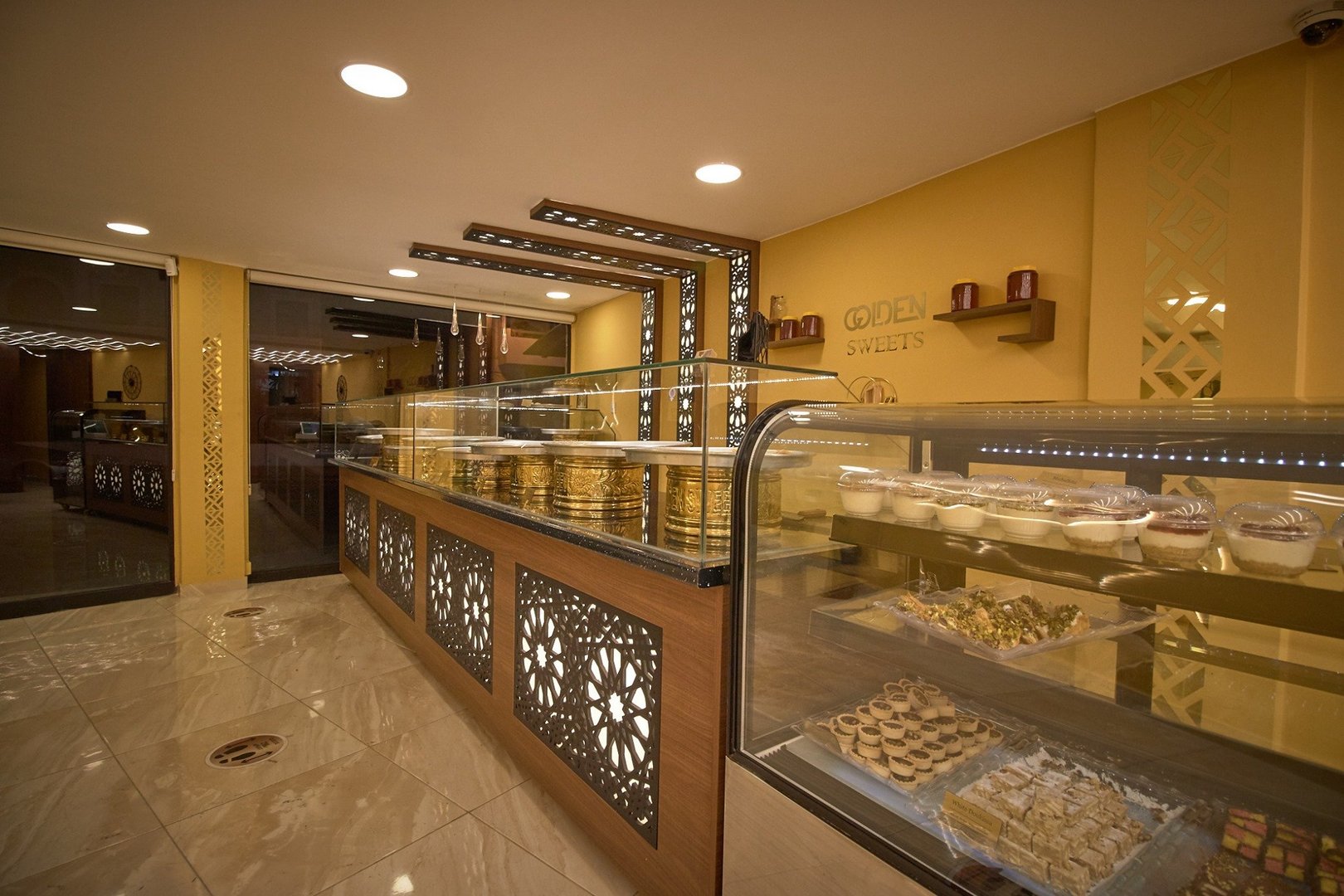
‘Golden Sweets’ opened just ten days ago, and the attention to detail is impressive. The shop’s interior is as luxurious as the sweets on offer, which are all made on site by his wife’s brother, experienced in creating these delights, and helped by Zoha.

“My family make all of the things here. The Syrian baklava is from our city, Aleppo, it’s all handmade and not rolled using a machine. We have all sorts of sweets and we have changed the names for everyone to understand what they are.”

Most of the customers so far are Cypriots, about 80 per cent, 15 per cent are Arab, and five per cent is ‘everyone else’, he said.

A selection of Golden Sweets (Bejay Browne)

Shikhoni’s modest, almost humble, approach to conversation is in direct contrast to the perfection he strives for.

His command of the English language is good, no mean feat as he is self-taught, and he was unaware of the word ‘entrepreneur’ but agrees the term describes him perfectly

“I’m just starting this business, but I hope to expand it. I will also start another company that will import and export catering equipment for hotels and other businesses. I am also coding still and am about to start another job as a technician for Apple products. I will also look for other opportunities in the future.”

His enthusiasm and drive are impressive, and sound exhausting, especially as the couple are also parents to a five-year-old daughter.

“She speaks Arabic, Greek and a little English. My wife speaks good Greek and I’m working on mine,” he said.

Shikhoni set up his new venture with financial help from his family, and also used money he brought with him from Syria. It took seven months to create the shop, which he designed. He delayed the opening by a couple of months as the design wasn’t completed and the coronavirus pandemic hit.

“I wanted everything to be special,” he said.

Determined to pay his family back every cent that he’s borrowed, they are proud of his achievement and his mother has been a great role model. She moved to Cyprus 15 years ago with his sister and had two dress shops in Polis Chrysochous.

“My mum is a businesswoman and a good example for me.”

It was on her recommendation that the couple decided to move to Cyprus.

“Things are difficult in Syria, and the climate in Cyprus is similar and the people are good. My mother said come here. It’s a good country to start your jobs and also good for your family, both for safety and for the future.”

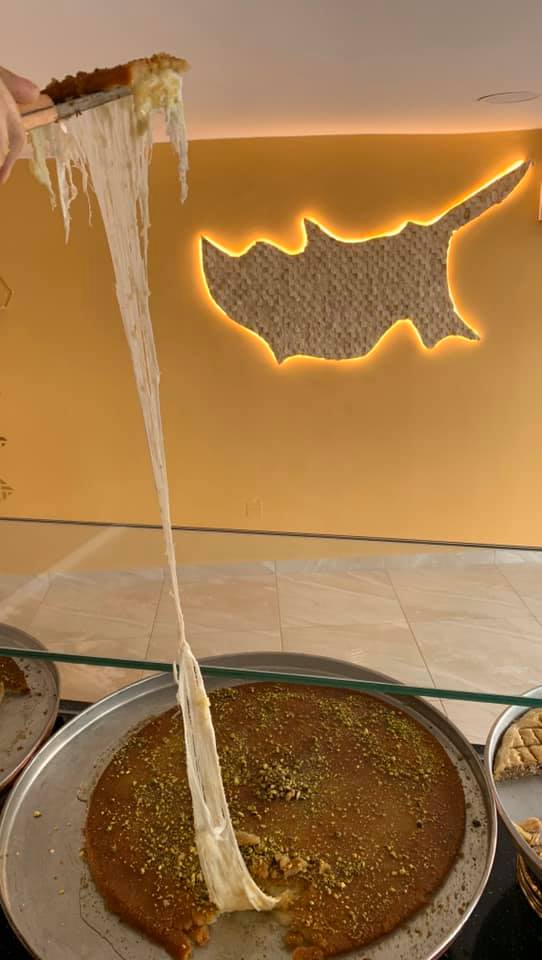
A map of Cyprus adorns the wall of the sweet shop

Shikhoni studied in Aleppo, and at university in Egypt. He describes himself as “just a normal man, always looking to the future”.

His love affair with Cyprus is apparent on entering his artistically designed shop.

Along with the inviting sweets on display, such as panna cotta cheesecake and small chocolate tarts, is a well-lit artwork depicting the island, to remind him, he said, of how welcoming Cypriots have been.

“I want it all to be perfect, and after three or four months I will also do something special, I think a first in Cyprus. I will make sweets with real gold that is edible. I will do luxury package for weddings and special occasions.”

The store is currently open from lunchtime until 10pm, but as things pick up, more staff will be employed, he said.

Mahmoud spent months perfecting the design of Golden Sweets

For the young businessman, his safety and that of his family is the most important driver.

“I don’t like guns or fighting and I’m always looking to the future for a safe and good life. I am always thinking to improve things for my family and me. In Syria, we can’t do this with the war. If you want to stay in Syria, you must use a gun, I don’t like that at all and don’t want to be involved in these things which are wrong. I always look for peace,” he said.

And even if his humble nature prevents him from wanting to be seen as a role model or advocate for the young Syrian refugee population of Paphos, Shikhoni is their unwitting champion, suggesting a special college for refugees to help them find and explore their passions and learn skills and a craft.

“I hope they make a small place like this for the refugees to find out what they like to do and help them to study. Some like photography or cooking, for example, and they need help and support. It would be good to find out what they are passionate about, this is important.”


Golden Sweets, Evagora Pallikaridi, Paphos - 26 040404


EUROPE MUST RESPOND TO TURKISH ACTIONS IN A UNITED WAY SAYS GOVERNMENT SPOKESMAN

Cyprus Mail 26 July 2020 - by Katy Turner

The Government spokesman

The response to Turkey’s unacceptable and extremely dangerous provocative behaviour that threatens stability and peace in the wider Eastern Mediterranean region can only be a united Europe, acting collectively and in a coordinated manner, Government Spokesman Kyriakos Kousios said on Sunday.

At a memorial service in Koutrafas he said “today we are facing the pressure but also the threats of Turkish expansion”.

He said Turkey continually shows belligerent behaviour by exercising complete control over the occupied areas with demographic change, threatening the settlement of Famagusta and its threats in the Exclusive Economic Zone which violate the Law of the Sea with the ultimate aim of exploiting its submarine energy wealth.

An example of political disrespect which confirms Turkey’s intransigence and authoritarian behaviour of, he added, is the transformation of Hagia Sophia into a functioning mosque

“Turkey’s illegal actions on the land and in the sea where the Republic of Cyprus exercises sovereign rights under international law must be stopped,” Minister of Transport Yiannis Karousos said at another memorial on Sunday.

“Having as our weapons international justice, achieving a just solution to our national problem is inevitable,” he said at a memorial ceremony for the fallen of Achna.

Our country, he added, is going through difficult times and “every day, unfortunately, we are witness to Turkey’s efforts to create new accomplishments.”


MOH DRAWS ATTENTION TO GATHERING AREAS FOLLOWING LIMASSOL RESTAURANT CASES

in-cyprus 26 July 2020 -by Josephine Koumettou


The Health Ministry stressed anew the importance of self-protection measures on Sunday after five employees at the Limassol branch of a restaurant chain tested positive to Coronavirus.

“Following the recent domestic cases of Covid-19 found in Limassol, particularly the five employees of Wagamama at Limassol Marina, we would like to draw the citizens’ attention to matters pertaining to their visits to areas with large gathering of people,” the Health Ministry said in an announcement.

It was clarified that all employees at the above restaurant have since taken the Coronavirus test and the premises were disinfected for two consecutive days as per the relevant protocol.

The Health Ministry reiterated that “we all have a personal and social responsibility to protect public health and to maintain our good epidemiological status,” adding that bringing back the lockdown measures will be the last resort and that “we all have an obligation to prevent this from happening.”

It was stressed that it is extremely important that all citizens continue to take self-protection measures despite the easing of the lockdown, especially when visiting crowded areas where social distancing is difficult to adhere to, like restaurants, supermarkets, malls etc. 

Moreover, the Health Ministry reminded that the use of a face mask is obligatory for employees who provide in-person customer service, like cashiers, supermarket/retail salespersons, waiting staff, food and drink makers in catering establishments etc.

“At the same time, distances should me maintained at all times between employees, especially during breaks when there is closer contact,” it was added.

Finally, the Health Ministry urged all citizens to monitor their own health, especially if they have visited areas where cases have been found, and contact their Personal Doctor immediately for instructions if they present Coronavirus symptoms, i.e. cough, fever, shortness of breath, anosmia, ageusia or dysgeusia.