Hızlı ve kolay bir şekilde sende web site sahibi olmak istiyorsan tek yapman gereken sitenin aşağısında bulunan iletişim formu üzerinden gerekli bilgileri girmen. Hepsi bu kadar.
Web Siteye Reklam Ver
Sende web sitemize reklam vermek veya ilan vermek istiyorsan. Tek yapman gereken sitenin en altında bulunan yere iletişim bilgilerini girmen yeterli olacaktır. Ekip arkadaşlarımız siziznle iletişime gececektir.
Web Sitemizin Yazarı Editörü OL
Sende kalemine güveniyorsan web sitemizde bir şeyler paylaşmak yazmak istiyorsan siteinin en aşağısında bulunan iletişim formunu kullanarak bizimle iletişime gecebilirisni
The Cyprus met office issued a yellow weather warning for Monday, due to extreme temperatures.
The warning is valid between 1pm until 5pm, an announcement by the met office on Sunday said.
Temperatures inland are expected to reach 40C and vulnerable groups such as the elderly and young children are considered high risk.
In the west coast, temperature is expected to be around 32C, approximately 34C in the remaining coasts and 31C in the mountains.
No respite is expected for Tuesday where the temperature is expected to increase slightly. It will continue to be higher than average on Wednesday and Thursday with a slight decrease in the mountains and inland.
British scientists analysing data from a widely-used COVID-19 symptom-tracking app have found there are six distinct types of the disease, each distinguished by a cluster of symptoms.
A King’s College London team found that the six types also correlated with levels of severity of infection, and with the likelihood of a patient needing help with breathing – such as oxygen or ventilator treatment – if they are hospitalised.
The findings could help doctors to predict which COVID-19 patients are most at risk and likely to need hospital care in future waves of the epidemic.
“If you can predict who these people are at Day Five, you have time to give them support and early interventions such as monitoring blood oxygen and sugar levels, and ensuring they are properly hydrated,” said Claire Steves, a doctor who co-led the study.
Besides cough, fever and loss of smell – often highlighted as three key symptoms of COVID-19 – the app data showed others including headaches, muscle pains, fatigue, diarrhoea, confusion, loss of appetite and shortness of breath.
The outcomes also varied significantly; some got mild, flu-like symptoms or a rash and others suffered acute symptoms or died.
The study, released online on June 16 but not peer-reviewed by independent scientists, described the six COVID-19 types as:
1 ‘Flu-like’ with no fever: Headache, loss of smell, muscle pains, cough, sore throat, chest pain, no fever. 2 ‘Flu-like’ with fever: Headache, loss of smell, cough, sore throat, hoarseness, fever, loss of appetite. 3 Gastrointestinal: Headache, loss of smell, loss of appetite, diarrhoea, sore throat, chest pain, no cough. 4 Severe level one, fatigue: Headache, loss of smell, cough, fever, hoarseness, chest pain, fatigue. 5 Severe level two, confusion: Headache, loss of smell, loss of appetite, cough, fever, hoarseness, sore throat, chest pain, fatigue, confusion, muscle pain. 6 Severe level three, abdominal and respiratory: Headache, loss of smell, loss of appetite, cough, fever, hoarseness, sore throat, chest pain, fatigue, confusion, muscle pain, shortness of breath, diarrhoea, abdominal pain.
Patients with level 4,5 and 6 types were more likely to be admitted to hospital and more likely to need respiratory support, the researchers said.
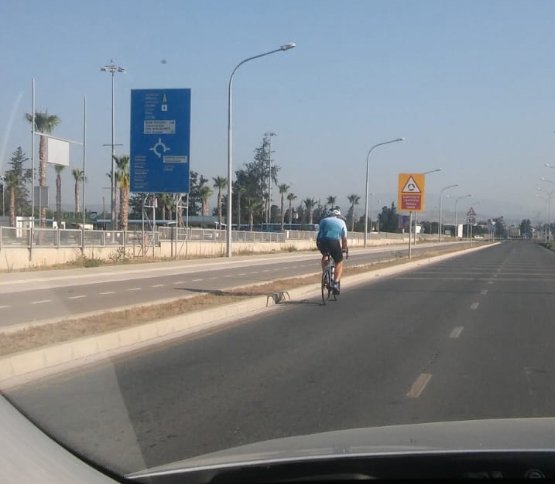
Two cyclists using the road instead of the cycle lane just centimetres away
A proper cycle lane network needs to be established, cyclists say
By Andria Kades
Cycling has certainly increased in popularity, but the harmonious co-existence of drivers and cyclists is still a long way off – and it’s not always the drivers’ fault.
Cypriot drivers are not known for their patience, and those eager to cycle often think twice, saying that there are not enough cycle lanes and that a careless driver will run them off the road.
So it is particularly baffling to see cyclists ignore cycling lanes where they do exist, and use roads instead, often when there is a perfectly functional cycling path just centimetres away.
Another cyclist who preferred the road to the cycle lane nearby
“It is so infuriating to see. I live next to the mall and there is a two-way cycling path in front of it,” Limassol resident Eleni Michaelidou told the Sunday Mail.
“The cycle lane has no potholes, cars cannot park there and is just fine to use. And yet I keep seeing cyclists cycle on the road right next to the cycling path next to them.”
National advisor of the Cyprus cycling federation Michalis Hadjioannou told the Sunday Mail that just because a cycling lane exists, doesn’t mean a network exists.
“Indeed, there are cycling lanes but often times it isn’t functional if you want to cycle to see a friend or go to work.”
A lane will only span so long before the cyclist has to get back on the road again.
“I can’t blame the cyclist for using the road instead of the cycling lane,” one driver told the Sunday Mail. “Once they get to the end of the cycling path, they have to use the road anyway.”
“Unfortunately not enough has been done. There are small developments but without a proper network in any city. No one can use cycling lanes properly,” Hadjioannou said.
Additionally, there may be lots of bumps along in getting to and from a road to the cycling lane, he added, making it harder for the cyclist.
There seems to be some confusion over whether a cyclist is breaking the law by using a road where a cycle lane exists. According to Hadjioannou, cyclists are allowed to be on the street, irrespective of a cycling lane.
His view was supported by two separate police officers but member of the traffic police Tasos Asikis, vehemently denied this was the case.
The amendment of the 2018 law regulating bicycles, states in table one, offence number seven, that a person using a bicycle who does not comply with road signs is subject to a €50 fine.
According to Asikis, as cycling lanes are pointed out with signs, not complying with them and instead using the street is an offence.
Where there is no cycling path or lane, cyclists are allowed to use the street.
Regulations also forbid cycling under the influence of alcohol or drugs and include a €50 fine for a cyclist without a light on their bike.
“Cyclists should not be considered a nuisance,” Hadjioannou said. People should be driving slowly in the city anyway and shouldn’t be irritated at having to be careful when seeing a cyclist.
“Let me put it this way. If someone is driving and there is a truck in front of them, they are patient until they can overtake them.”
More cyclists means less traffic, Hadjioannou pointed out. “Those people on bicycles could have been in cars instead increasing traffic.”
It is the lack of proper education in Cyprus that prevents us from seeing it that way, he said.
The island is obviously long way off countries like the Netherlands where cycling is a part of daily life, but rather than create more paths for bicycles, time needs to go towards making proper networks allowing people to use bicycles safely and cohesively, Hadjioannou said.
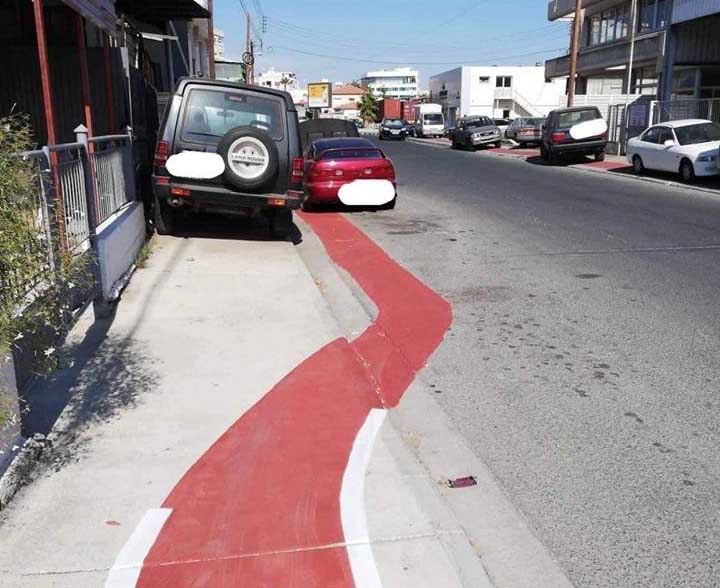
The absurd ‘cycle’ lane literally painted around parked cars which was ridiculed on social media
The tragi-comic epitome of this was the crooked, shoddily painted Limassol bicycle path largely blocked by parked cars which was ridiculed on social media last year, prompting the municipality to promise to investigate and correct the ‘shameful’ embarrassment.
The bicycle path in the area of Omonia Street area was supposed to connect the Limassol Marina with the western areas of the city up to the new port, but it was nothing short of a joke, swerving across roads and even around parked cars.
Michaelidou said she would have loved to cycle in Cyprus but she just felt it to be a health hazard. “My dad wanted to cycle to work which wasn’t too far away, but I was too scared.”
While Hadjioannou defends a cyclists’ right to ignore a cycle lane, he concedes that some cyclists do themselves no favours as they ride three abreast on the road.
According to Hadjioannou, cyclists are allowed to drive on the left side of the street with a maximum of two people side-by-side. Though some drivers get irritated because it’s harder to overtake, it’s safer for cyclists this way and allows drivers to see them easily.
The spike in cycling is a direct result of two recent crises. One was in 2013 during the financial crisis and then recently during the coronavirus pandemic, Hadjioannou said.
Some who had never cycled decided to start and those who cycled decided to cycle more frequently, he added.
“It allows people to escape their problems, to feel better. Especially when cycling in nature when you can cover large distances using your own strength, it really helps people relax,” he said.
“Cyclists have rights too. They are a solution to traffic, the economy, health and the environment.”
The black-headed ground snake is thin and non-venomous
By Bejay Browne
A new snake discovered in Cyprus has now been scientifically identified and confirmed, thanks to the efforts of a local herpetologist.
This brings the total to nine species of snakes living in Cyprus.
Hans-Jörg Wiedl, better known as ‘Snake George,’ discovered the ninth snake, the black-headed ground snake, which is thin and non-venomous and is an endemic sub species of the Rhynchocalamus melanocephalus was living in Cyprus.
He initially discovered it in 2013 and this was followed by a second specimen found in 2017 by someone else. The herpetologist then encountered another specimen in 2018.
“I am absolutely thrilled and over the moon. It’s like an early birthday present for me, as I shall turn 77 in August. I am also very proud and happy for Cyprus and we now have nine snakes,” he said.
Snake George thoroughly researched the tiny snake and discovered that a similar one is endemic to the East Mediterranean and has also been found in Turkey, Syria and Israel.
There need to be three sightings of a snake alive to be able to prove its existence, a single example is not evidence. To prove that this is a new species, DNA identification, research, findings and examples of the snake must be identified.
So, in order to identify the species genetically, Snake George cooperated with a well-known scientific team from the Zoology Department in the University of Israel, he said, who among others performed DNA analysis on specimens found in Cyprus.
Hans-Jörg Wiedl better known as Snake George
The non-venomous snake belongs to the Colubridae family like the commonly found Large Whip snake, he added. The species is found in most neighbouring countries to Cyprus that share similarities in climate and habitat.
“In the Eastern region it is commonly known as the black-headed ground snake due to its small size and colour. It feeds mainly on larvae, small insects and lives in difficult to reach rocky areas,” he said.
The discovery of the existence of the ninth snake of Cyprus and all of the methodology is now officially published in ’Zoology in the Middle East’.
“Further research is needed to be carried out on its population, but once again this proves that our island is small but yet so rich in biodiversity.”
The popular Paphos resident is well known in the field of herpetology and has a string of triumphs to his name including rediscovering the Cyprus grass snake, which was believed extinct, and proving that the blunt nosed viper lays eggs and doesn’t give birth to live young as had previously been thought.
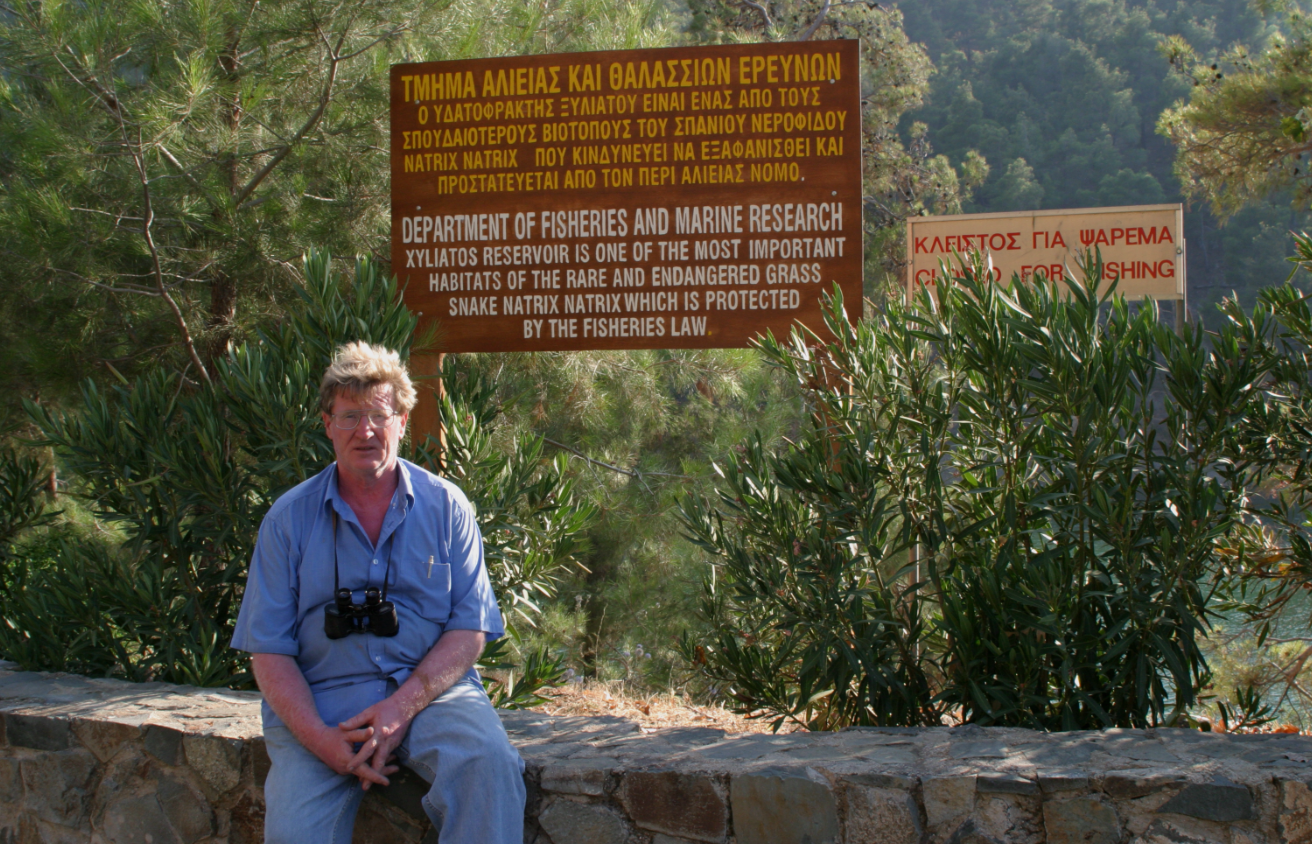
He also rediscovered the Cyprus Grass snake after it had been thought extinct for nearly 40 years.
Snake George has been fighting for the protection and conservation of Cyprus reptiles for more than 30 years and said that he is grateful to see that more and more people are supporting this ‘important path’.
“I still receive almost daily calls and emails from people who need help in cases where they encounter a snake or have questions about reptiles and amphibians and I always do my best to help out in every case,” he said.
The reptile expert was also a former UN peace keeper was honored by the Swiss company Rolex, and awarded the ’’Cross of Honour for Science and Art’’ by the Austrian president for his contribution towards the protection and conservation of the Cyprus reptiles and amphibians.
He is also the author of the ‘’Snakes of Cyprus’’ which is translated into four languages, and co-writer of ‘’The Amphibians and Reptiles of Cyprus’’, he is also the co-founder of the Cyprus Herpetological Team.
For many years, he owned and ran ‘Snake George’s Reptile Park’ in Peyia, in Paphos, which was enjoyed by visitors from all over the world including students from abroad doing their internships.
Snake George has also given numerous talks to enlighten the public about the important herpetofauna in Cyprus.
The aim of these talks is to raise awareness of the protected status of the Cyprus reptiles and amphibians.
“It is also to try to help to erase the public’s general prejudice against snakes,” he said.
President Nicos Anastasiades recently laying the cornerstone of the new LNG terminal signalling that Cyprus is making long-term commitments to importing gas.
By Charles Ellinas
GREECE is fast becoming one of the lead countries in Europe in the adoption of renewables. Last year the country was ranked 9th in the world, with about 29% of energy coming from renewable energy sources (RES), including hydroelectric, wind and photovoltaic (PV). By 2030 the RES contribution is expected to exceed 60%.
In fact, not only Greece is on-track to meet and exceed its ambitious 2020 targets, but it has set even more ambitious targets for the period 2021-2030, even exceeding EU targets.
It also plans to cease using lignite and coal for power generation by 2028. A major step in Greece’s green evolution, given that lignite has been central to its electricity production since the 1950s.
The government also introduced legislation in May cutting red tape for renewable energy projects, reducing project approval times from over six years to under six months.
Greece’s economy suffered massively in the aftermath of the global financial crisis of 2008. This year it expects a crippling GDP drop of 9.7%. But if anything, these economic challenges have galvanised efforts to turn the country’s energy to renewables. And for a good reason. During the second half of 2019 Greece’ household electricity prices were just over 15 euro-cents, well below the EU-average. Cyprus’ prices were 50% higher!
The adoption of a competitive system based on public auctions has been a major contributor to bringing unit prices down. The latest PV tender issued in April has been capped at just over 6 euro-cents/kWh. The lowest price was achieved at an auction in April, down to 4.9 euro-cents/kWh.
National Energy and Climate Plan (NECP)
Unlike Cyprus’ National Energy and Climate Plan for the period 2021-2030, that was sent back a number of times as being inadequate, Greece has fully embraced Europe’s lead.
Prime Minister Kyriakos Mitsotakis said in May “Greece was one of the first countries to embrace the ambitious EU plan for an economy without a carbon footprint by 2050…In our view, these policies are not just EU obligations but great opportunities which are already being realised.”
Greece’s final NECP requires renewables to supply 35% of final energy consumption in 2030. Of this, RES is targeted to contribute a massive 61% of the country’s electricity consumption. Renewables will also provide 43% of Greece’s heating and cooling and 19% of its transportation needs by 2030.
Greece’s NECP has also committed to reduce carbon emissions by 55% by 2030 in comparison to 2005. Cyprus has been pushed by the EU to accept a 24% reduction, but even then it warns that it may not be able to achieve it, with substantial cost implications to the Cypriot consumer in terms of carbon emission penalties.
Greece is proud to claim that its new energy plan not only provides for greater energy efficiency, electric mobility, but will also ensure a truly competitive electricity market.
During the energy transition period to 2030, Greece’s generation mix will move completely away from lignite, to a combination of renewables and natural gas. But even then, the contribution of natural gas will decline from 44% in 2019 to 32% by 2030.
In order to support this transition and RES penetration, subject to grid safety and technical limitations, renewable energy power plants are entitled to priority dispatch of their power output. This means that the off-taker is legally obliged to off-take RES power at regulated feed-in tariffs and the competent grid and market operators must ensure that the off-take takes priority over electricity produced from conventional energy sources.
The estimated cost of implementing this plan is €44 billion. Greece hopes to get a €32 billion boost from EU’s Recovery Package to help with this.
Greece now among top renewable energy countries
REN21, the globally accepted global renewable energy policy network, in its Renewables 2019 Global Status Report said Greece is among the top nine countries worldwide generating more than 20% of their electricity from RES.
REN21 states that Greece’s success is based on a combination of attractive market conditions and regulations that encourage RES growth. These have been enticing new investors, domestic and international, that bodes well for the future of the RES industry.
Earlier this year, German investors entered into a sale and contract agreement with HELPE Renewables, for Greece’s largest renewable energy project to date, the 204.3 MWp solar PV power Project Kozani. This will be among Europe’s five largest PV parks, and the largest in South-East Europe. The project highlights the enormous potential of solar energy not only in Greece, but the whole region. Something that Cyprus can and must emulate.
Government incentives and efforts, coupled with a positive attitude toward renewables from the public, mean that Greece’s dependence on fossil fuels will diminish substantially during the next ten years.
And in Cyprus?
While Greece is pushing ahead and benefiting from its renewable energy plans, what is Cyprus doing? Two articles this week exemplify the sorry state of affairs.
One by Charalambos Theopemptou, MP, is not just revealing, but it demonstrates a persistent malaise that should not make us proud. He said “Cyprus seems to have resorted to alchemy to convince the EU that it has made progress in the use of RES, by including the burning of wood for heating purposes, ie wood that was cut by citizens mainly from burned forests to light fireplaces and wood stoves, as RES.” This subterfuge, he says, has been used to show that Cyprus achieved its 2020 target of a 13% RES penetration to its total energy consumption. A target that otherwise would not have been achieved.
The other was by Andreas Poullikkas, president CERA. He says, “To date, no attempt has been made to formulate a comprehensive long-term energy strategy and policy based on a broad partisan consensus…the energy impasse we live in is more than obvious.” He added “We need today to reverse the current energy situation, to reverse the current wasteful and dead-end development model and to bravely turn to green technologies and energy efficiency policies.” I could not agree more.
Instead of wholeheartedly adopting and promoting renewables, taking its cue from Greece, Cyprus is going backwards. It is making long-term commitments to importing natural gas and in the process stifling the development of its own gas fields and abundant renewables – all to the detriment of the Cypriot consumers and industry, who unfortunately pay the cost.
Dr Charles Ellinas, Senior Fellow Global Energy Centre, Atlantic Council
Health Minister Constantinos Ioannou on Sunday said that an increase in Covid-19 cases was expected and inevitable after the opening of the holiday island’s airports.
He also urged people once again to follow all protective measures and protocols to limit the spread of the disease.
The message he sent out was that corona-virus has not left us and no complacency should prevail even though Cyprus is on the right track.
The number of tests have doubled after a cabinet decision last week, in an effort to identify as many positive cases as possible.
As for the divided island’s checkpoints, the minister said that no final decision has been made.
The problem, he added, is mainly with asylum seekers who arrive to the Turkish-occupied areas and then pass to the internationally-recognised Republic through the buffer zone.
All those who are transferred to reception camps in the Republic are tested for Covid-19 before admission.
Sky News 19 July 2020 - by Tom Gillespie, News Reporter
The World Health Organisation reported a record increase in global coronavirus cases for the second day in a row on Saturday as the total rose by 259,848 in 24 hours.
The biggest increases were in the US, Brazil, India and South Africa, according to a daily report.
The previous WHO record for new cases was 237,743 on Friday.
Deaths rose by 7,360 - the biggest one-day increase since 10 May.
Deaths have been averaging 4,800 a day in July, up slightly from an average of 4,600 a day in June.
Total global coronavirus cases surpassed 14 million on Friday, according to a Reuters tally, marking another milestone in the spread of the disease that has killed nearly 600,000 people in seven months.
The surge means that one million cases were reported in under 100 hours.
The WHO reported 71,484 new cases in the US, 45,403 in Brazil, 34,884 in India and 13,373 in South Africa.
India became the third country in the world to record more than one million cases of the new coronavirus on Friday, behind only the US and Brazil.
Epidemiologists say India is still likely months from hitting its peak.
Cases in Brazil crossed the two million mark on Thursday, doubling in less than a month and adding nearly 40,000 new cases a day.
A patchwork of state and city responses has held up poorly in Brazil in the absence of a tightly-coordinated policy from the federal government.
The US, which leads the world with over 3.7 million cases, has also tried to curb the outbreak at state and local levels with only limited success.
A new tourism product scheduled to launch in the beginning of 2021 will help spread tourism to the mountain and rural areas of the island, the Deputy Minister of Tourism Deputy Minister of Tourism Savvas Perdios told the Cyprus Mail on Friday.
Perdios revealed the launch of a new 300km authentic route in the mountain and rural areas of Cyprus which “is really going to change the game for Cyprus.”
“It’s a route which is also physical, so on the ground, but also digital” Perdios said. Travellers will be able to book their customised experience digitally, choosing exactly the activities that match their interests.
“Targeted digital marketing is the way forward for the Cyprus tourism industry,” the minister said, adding that this is part of an effort to create individual tourism.
Experiences will vary from visiting non-conventional sight-seeing areas, or visiting the home of a Cypriot family and learning how to cook a traditional meal, or endorsing in agriculture activities such us making halloumi or picking up olives.
“The whole point is for people to be able to book these experiences digitally on an individual basis, so in that way we are customising an experience for the traveller and at the same time we are pushing business towards the authentic areas of Cyprus” Perdios added.
Currently, the main attraction for tourists is the island’s sun and the sea which targets families. However, part of the national tourism strategy until 2030 is to attract different source markets, nationalities and age groups by spreading tourism through the whole island.
In July last year, cabinet approved the implementation of a National Strategy for mountain communities which includes a number of ongoing projects aiming to promote tourism and support farmers.
“I think unless we do more to develop and promote the mountains and rural areas in Cyprus is going to be impossible to change or diversify the source markets and segments that we are attracting” Perdios explained.
With the new product, travellers will be able to get a hands-on experience of the local products and traditions.
The exact location of the product will be announced in the first months of 2021.
Transport Minister Yiannis Karousos inspecting procedures at the airport (Christos Theodorides)
Cyprus is ready to welcome more tourists taking all precautionary measures against Covid-19, Transport Minister Yiannis Karousos said on Sunday.
Speaking to the press, the minister said that authorities are following all necessary protocols and procedures in order to reduce the risk of spreading the virus. He said that when the flights resumed and the airports opened, there were only a few flights and a few hundred passengers but now we have reached approximately 6,000 passengers on a daily basis. According to the minister, the air traffic will increase, since UK will be added to category B as of August 1.
Karousos added that new flight destinations are added from and to Cyprus. He said direct flights are added to France, from two airports in Denmark and from several airports in Germany, noting that there is an increased number of tourists from Switzerland and Austria.
Transport Minister said however that these are difficult times and we are gradually opening the airports and the flights, pointing out that it is important to maintain the advantages we have as a country so that we can attract more tourists.
Invited to comment on complaints by passengers on a flight from Germany that their temperature was not taken, the minister said that a thermal camera records the temperature of the passengers . He also explained that Germany is a category A country and no negative Covid-19 test is needed to travel to and from the country. He added that random tests are carried out by the health ministry.
Karousos noted that Greece is also a Category A country and added that the classification of various countries is done based on specific epidemiological data.
Sorry! The content you were looking for does not exist or changed its url.
Please check if the url is written correctly or try using our search form.
Bigger Archive Portal
Other portals
World War I , Africa ,United States of America ,Anime and manga ,Ankara ,Anthropology ,Military • Astronomy • Asia • European Union • Azerbaijan • Azerbaijan (Iran) • BBC • Beşiktaş • Science • History of science • Biography • Byzantine Empire • Bosnia -Herzegovina • Jazz • Sexuality • Geography • China • Language • Religion • Literature • Energy • Armenia • Eurovision • Evolutionary biology • Philosophy • Feminism • Fenerbahçe • Palestine • Physics • France • Football • Galatasaray • South Korea • Georgia • Harry Potter • Aviation • Hinduism • Christianity • Iraq • England • Human rights • Internet • Iran • Islam • Istanbul • Scouting • Izmir • Japan • Kazakhstan • Cyprus • Kuwait • North Korea • North Macedonia • Culture • Lady Gaga • LGBT • Liberalism • Madonna • Mathematics • Media • Mexico • Michael Jackson • Mustafa Kemal Atatürk • Music • Middle East • Middle World • Ottoman Empire • Automobile • Free software • Pakistan • Psychology • Russia • Art • The Simpsons • Cinema • Politics • Socialism • Soviet Union • Sports • Syria • History • Technology • Television • Terrorism •Medicine • Theater • Society • Turkish Armed Forces • Turkish history • Turkey • Video games • Judaism • Stargate





 Kayıtlar


