Bayram Cigerli Blog

Bigger İnfo Center and Archive
  • Herşey Dahil Sadece 350 Tl'ye Web Site Sahibi Ol

    Hızlı ve kolay bir şekilde sende web site sahibi olmak istiyorsan tek yapman gereken sitenin aşağısında bulunan iletişim formu üzerinden gerekli bilgileri girmen. Hepsi bu kadar.

  • Web Siteye Reklam Ver

    Sende web sitemize reklam vermek veya ilan vermek istiyorsan. Tek yapman gereken sitenin en altında bulunan yere iletişim bilgilerini girmen yeterli olacaktır. Ekip arkadaşlarımız siziznle iletişime gececektir.

  • Web Sitemizin Yazarı Editörü OL

    Sende kalemine güveniyorsan web sitemizde bir şeyler paylaşmak yazmak istiyorsan siteinin en aşağısında bulunan iletişim formunu kullanarak bizimle iletişime gecebilirisni

Oh What A Day!

I stepped in dog poop twice today. Twice in one day, what are the odds of that? Both times I was wearing my sneakers and of course the poop was inbedded deeply in the tread. Where I was there was no grass, only cobblestoned streets, which do nothing to aleviate my problem. I scraped and I scraped but nothing. On the other hand, the city that I am in is beautiful. It more than makes up for the fact that I smell like crap (literally!)

I wonder what is next?


Wow, P.Z. sure is popular!


Yesterday, P.Z. Myers announced: Yes, I will be HALF A CENTURY OLD tomorrow. He invited everyone to write a poem for his birthday. As of right now, that posting has received 166 comments, most containing poetic birthday wishes.

Gee, he's popular.

The picture on the right is from Richard Dawkins's website. Dawkins started the greetings-in-rhyme with the following:

All around the World Wide Web, the wingnuts get the crepys,
As the faith-heads take a drubbing
from our era's Samuel Pepys,
That sceptical observer of the scene about the wyers,
At Pharyngula, the singular redoubt
of P Z Myers.

Happy birthday, P.Z.!

UPDATE: He has A LOT of friends. If your internets seem slow today, it's because everybody is wishing P.Z. happy birthday. See here, and here, and here.

Willie Lynch: The Making of a Slave

Trying to clear off the corner of a desk that has become rather cluttered the last few days, I came across something a student gave me last week. He asked if I'd ever heard of Willie Lynch's speech. I said I hadn't, so he gave it to me, printed out from this website. (It's much easier to read, though, here or anywhere else you can find it.) I put it on the side of the desk, and before long it was covered and forgotten. I rediscovered it a few minutes ago.

The speech begins:

Gentlemen. I greet you here on the bank of the James River in the year of our Lord one thousand seven hundred and twelve. First, I shall thank you, the gentlemen of the Colony of Virginia, for bringing me here. I am here to help you solve some of your problems with slaves. Your invitation reached me on my modest plantation in the West Indies, where I have experimented with some of the newest and still the oldest methods for control of slaves.


After the first sentence, I had my doubts. A quick Google search seems to confirm. Fake. Hoax.

I’m probably the last person in the world to see this, right?

"They only call it class war ..."

I found this wonderful picture at a posting from gottlieb titled "All Revolution is Class War" over at Progressive Historians. I won't bother quoting or even describing the piece; if the guy holding the sign doesn't make you want to read it, you probably wouldn't enjoy it. (Come to think of it, that probably means you should read it. Just click above.)

History Enthusiast takes on "The Lost Tomb of Jesus"

Kristen, over at The History Enthusiast, has a great post on "Decoding The Lost Tomb of Jesus." Good analysis, but I was especially interested in how she compared the names recorded in the tomb--
Jesus, son of Joseph
Maria
Matthew
Yose
Mariamne e Mara
Judah, son of Jesus
to the listings she found in an 1850 slave schedule from Missouri--
24-year old mulatto male
20-year old black male
18-year old black female
15-year old mulatto female
6-year old black female
3-year old black female
What are the familial conections? How can we be sure?

"Southern Pasts": A new, must-read blog

I just came across a new (two week old) blog, Southern Pasts. The "sub-title," if that's the right word, is "The past is not dead," the first half of a famous line from William Faulkner's Requiem for a Nun; the conclusion, "it's not even past," proves that Faulkner was one of the greatest southern historians ever.

Southern Pasts is beautiful in both its layout and its writing. The author introduces it thusly:

The title of this blog, Southern Pasts, borrows from the titles of two books on the history of the South. The first is Fitzhugh Brundage’s recent monograph, The Southern Past: A Clash of Race and Memory. The second is Melton McLaurin’s award-winning memoir, Separate Pasts: Growing Up White in the Segregated South.


Given its namesakes, this blog will address issues related to southern history and how people remember it, particularly with regard to race. I deliberately chose McLaurin’s plural “pasts” because I believe that the South is a region with a still largely segregated understanding of the past. In terms of historical memory in the South, there are often (as the cliche goes) two sides to every story.


One of my goals as a historian is to complicate (dare I say, integrate?) the “separate pasts” of the South, both black and white, and it is with this goal in mind that I began this blog.


I urge you to read it.

Best wishes, Southern Pasts!

Getting LOST

Since I'm too worthless these days to post anything here, I'm passing along a link to LOST Magazine, described by the publisher as "an online monthly magazine that combines elements of many other literary, online, and national magazines with a singular mission--to reclaim in writing lost people, places, and things."

I haven't read much of it yet, but what I've seen is quite good.

Land Travels: Camping, Caves, and Crazy Times

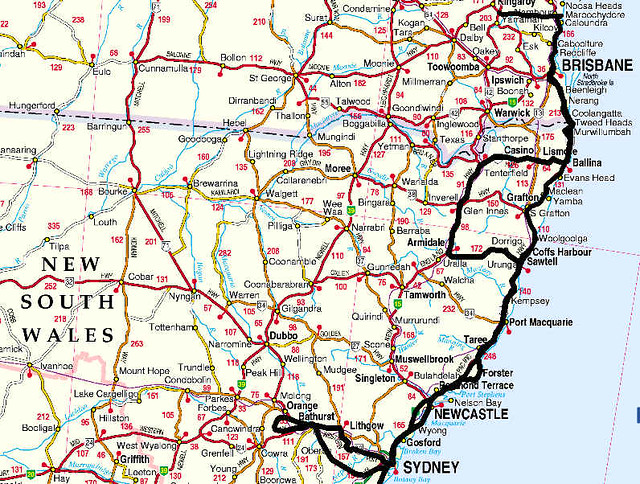
We are having a grand time trekking through the Eastern side of Australia. Billabong is safely docked in Mooloolaba and as of the 20th of February we have been putting on the kilometers in our rented “campette” campervan. As of today we have made it just past Sydney, less than 1,000 km if driven straight … however we have driven over 2,500km! We have explored the coast and the neighboring hinterlands; traveling flat coastal breath-taking views to mouth-gaping dramatic mountain roads. Australia is yet another beautiful country, and we are yet again thankful for the opportunity to be here.

One thing we have learned about the Australian’s is that they sure do know how to camp … and they don’t go skimpy! More than once on our cruising journey, I have found that I’ve had boat envy … sometimes a wee-bit jealous of the big, more luxurious boats (more properly called yachts). I still remember the day I stepped aboard a beautiful 70 foot sailboat and was handed a chilled glass of white wine in a REAL wine glass! I never thought such envious thoughts could be found in camping too. We look quite pathetic in our tiny ‘campette’ (basically a small van with a bed and camp-stove) when we pull into a campground and are surrounded by HUMONGOUS camping setups … some of these tents are bigger than the average home! We’ve even had more than one local comment on how small our little guy is! And so, as we drink our barely cool white wine from lovely blue plastic cups, I can’t help but stare longingly at the campsite next to us as they drink their fully chilled wine, in the protection of their net enclosed social area, in, of course, a real wine glass!!!

But of course for us life is grand, and even if we tend to be a bit envious here and there, there is no time to dwell on it as the sites are just to numerous and wonderful to care about how one got there to see them in the first place!

Our favorite Australian site to date is the Jenolan Caves in the Blue Mountains National Park (just west of Sydney). Honestly, I can’t even begin to describe the wonder and amazement of this magical place. I never would’ve guessed that caves could be so interesting and beautiful. Both of us have tried to come up with expressions and descriptions, but it is useless … they were (are) just amazing and no words or photographs will ever do them justice!

Besides great hiking and walking, superb views and lookouts, and exploration of towns and cities, we have also experienced one of the highlights (according to Lonely Planet) of Sydney … the Mardi Gras. Now this isn’t to be compared to the New Orleans Mardi Gras … this is the Gay & Lesbian Mardi Gras and boy oh boy is it the most unique and, er’, interesting parade I’ve ever seen! We were lucky enough to be in Sydney for this great festivity, and even luckier to meet up with our friends on Island Sonata. There are some things that just can’t be written about this parade, less I’m kicked off this BLOG site for pornographic material!!! About half a million folks attended and it was quite a scene to take in, especially some of the ‘outfits’ or lack there of. If you can handle the crowds it’s something not to be missed should you be in town during the event.

Next up we’ll continue our travels south, to Melbourne, where we’ll board a plane to fly over to Tasmania, spending nine days on the island before returning to Sydney, and eventually Billabong back in Mooloolaba.

Road Trip Brisbane to Sydney Photos

2/20/07 - 3/4/07

brisbane-sydney


2/20 - 2/23:  Brisbane to Coff's Harbour

Mt Warning National Park, Tenterfield & Bald Rock NP, Washpool / Gibralter Range, Yamba, Coff's Harbour, Sawtell


2/23 - 2/27:  Dorrigo to Broken Bay

Dorrigo National Park, Nambucca Heads, Trial Bay / Southwest Rocks, Crowdy Bay, Port Stephens, New Castle, Pittwater/Broken Bay, Ku-ring-gai Chase National Park


2/28 - 3/01:  Blue Mountains

Wentworth Falls, Leura - Katoomba, Blackheath, Three Sister's, Jenolan Caves


3/2 - 3/4:  Sydney

Including the Gay and Lesbian Mardi Gras

Marian Sims and Reconstruction in S.C.

In response to a posting yesterday where I noted that I'm working on a conference paper and need to finish it during our spring break, a reader asks what the paper is about.

The paper is for the annual meeting of the Georgia Association of Historians and is titled, rather boringly, "Beyond Surrender: Marian Sims, Francis B. Simkins, and Revisionism in Reconstruction South Carolina."

Marian Sims (1899-1961) was a writer born in Dalton, Georgia. In the mid-1930s, Sims, who had been a school teacher (history and French) and copy writer for an advertising firm, began writing novels and short stories. Much of her fiction dealt ("with notable honesty and intelligence," according to a reviewer in the New York Times) with the lives of middle-class southerners facing such issues as divorce and small-town religious and moral bigotry.

In 1941, Sims turned her hand to historical fiction with Beyond Surrender, a novel of Reconstruction in South Carolina. In the book's acknowledgements, she thanked Francis Butler Simkins, who was the author (with Robert Woody) of one of the first of the so-called "revisionist" histories of Reconstruction (South Carolina during Reconstruction, [1932]).

Earlier historians (and people in general) had looked at Reconstruction as a dismal failure, where vindictive northern Radical Republicans imposed horrible "reforms" on the southern states. This interpretation features scalawags and carpetbaggers, uppity and incompetent blacks, and whites being humiliated and, in general, unfairly imposed upon. William Archibald Dunning and his students (the "Dunning school") at Columbia a century ago turned out a number of studies that "proved" this interpretation. (Perhaps the most popular "history" was Claude Bowers's The Tragic Era [1929]). Think of Birth of a Nation and Gone with the Wind, and you'll understand how widespread this view was.

Historian Francis B. Simkins was no Eric Foner, but his view of Reconstruction was quite different from Dunning's. In Simkins's view, not all Yankees were bad, not all southern whites were good, and the former slaves were treated with a sympathy that even W.E.B. DuBois pronounced "fair."

A reading of the Sims-Simkins correspondence and the two books (Sims's novel and Simkins's history) shows that Sims was heavily influenced by Simkins's work, producing what might well be the first "revisionist" fiction of the Reconstruction era, a much improved version (from a historical standpoint, anyway) of Margaret Mitchell's more famous novel.

Sims has been almost completely ignored by historians, and I think that's a shame, hence the paper.